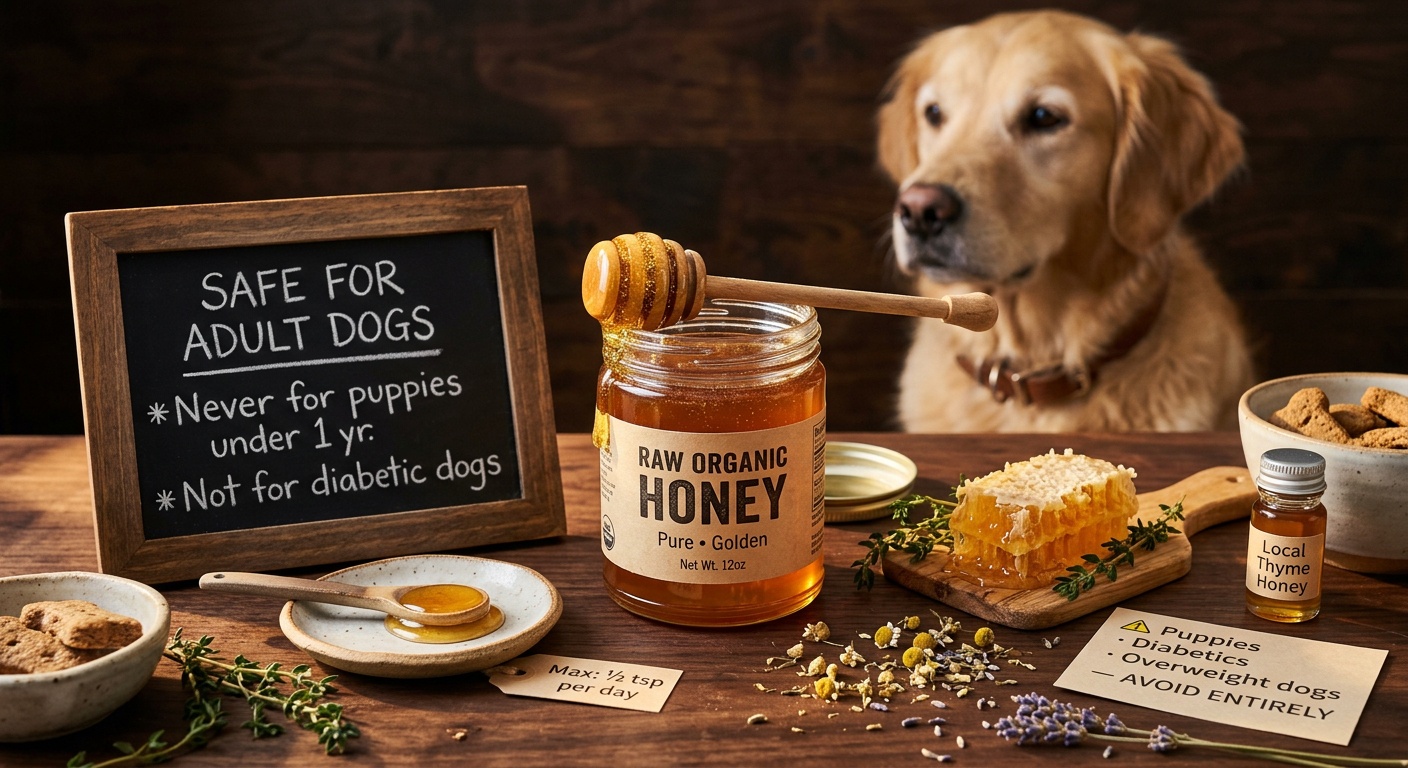
Can dogs eat honey?
Yes — raw honey is safe for healthy adult dogs in small amounts. It contains natural sugars, antioxidants, and trace amounts of vitamins and minerals. However, it should never be given to puppies under 12 months due to the risk of botulism spores, and should be avoided in diabetic or obese dogs due to its high sugar content. Stick to a maximum of one teaspoon per day for large dogs, and far less for small breeds.
Is Honey Safe for Dogs?
Yes, in moderation. Raw honey has been used as a natural remedy for thousands of years and contains a genuinely impressive nutritional profile — natural enzymes, antioxidants, trace minerals, and small amounts of B vitamins. For healthy adult dogs, a small daily amount is perfectly safe and may offer some real benefits.
The catch is the sugar content. Honey is approximately 80% sugar by weight. That is not a problem in tiny amounts, but it becomes one if you are spooning it generously into your dog's bowl every day. Too much sugar over time contributes to weight gain, dental decay, and can cause digestive upset in one sitting.
Yes — Safe in Small Amounts for Healthy Adult Dogs
Raw honey is a natural food with real nutritional benefits. Given in the right amount to the right dog, it is a perfectly safe occasional treat or supplement.
Who Should NEVER Have Honey
Before you reach for the jar, check whether your dog falls into any of these groups — for them, honey is off the menu entirely.
🐶 Puppies Under 12 Months
Raw honey can contain Clostridium botulinum spores. In adult dogs these are completely harmless — a mature gut microbiome outcompetes the spores before they can do anything. In puppies under 12 months, the gut flora is still developing and cannot reliably suppress them. If those spores germinate, they produce botulinum toxin, which causes muscle paralysis. Yes, puppies eat all sorts of disgusting things off the floor — but bacteria and pathogens are handled by the immune system differently. Botulism bypasses that. Best avoided until 12 months.
🩺 Diabetic Dogs
Honey causes a rapid spike in blood sugar. For a diabetic dog this can be dangerous and may interfere with insulin management. Avoid completely.
⚖️ Overweight Dogs
One teaspoon of honey contains around 20 calories — almost entirely from sugar. For a dog that is already carrying extra weight, this is empty calories that will make the problem worse.
🐾 Compromised Immune System
Dogs on immunosuppressive medications or undergoing chemotherapy should avoid raw honey. The risk of infection from spores or pathogens is higher when the immune system is suppressed.
⚠️ Why Puppies Specifically — And Not Just "They're Delicate"
It is a fair question — puppies eat mud, lick bins, and chew things they absolutely should not. So why does honey get a warning? The reason is specific: raw honey can carry Clostridium botulinum spores. When puppies eat something with bacteria in it, their immune system mounts a response and fights it off. That is normal. Botulism works differently — the spores settle in the gut and, if the gut flora is not mature enough to crowd them out, they germinate and produce toxin internally. The immune system does not get a chance to intercept it. Adult dogs and adult humans have a fully established gut microbiome that outcompetes the spores before they can produce anything. A puppy's gut is not there yet. This is the same reason human infants under one year old are never given honey — same mechanism, same logic. Once your dog is past 12 months and their gut has developed fully, honey is fine.
What Type of Honey Is Best for Dogs?
Not all honey is equal. The type you choose matters quite a bit.
🏆 Raw Honey — Best Choice
Unprocessed, unheated honey that retains all its natural enzymes, antioxidants, and pollen. This is the most nutritionally complete form. Look for "raw" on the label. Local raw honey is ideal.
🌿 Manuka Honey — Therapeutic Grade
Produced in New Zealand from the Manuka bush, this honey has exceptional antibacterial properties due to its high methylglyoxal (MGO) content. Often used topically for wound healing as well as orally.
✅ Local Wildflower Honey
Raw local honey may help reduce seasonal allergy symptoms in some dogs by introducing local pollen in tiny amounts — though scientific evidence for this is limited. A popular choice among natural feeding advocates.
❌ Processed / Commercial Honey
Supermarket honey is often heated, filtered, and may be blended with corn syrup. The heating destroys beneficial enzymes and antioxidants. It is still safe but has significantly less nutritional value than raw honey.
How Much Honey Can I Give My Dog?
Less than you think. Honey should always be treated as an occasional treat, not a daily supplement. The serving sizes below are the maximum — less is always fine.
| Dog Size | Weight | Max Daily Amount | Calories Added |
|---|---|---|---|
| Toy / Extra Small | Under 5kg | ¼ teaspoon | ~5 kcal |
| Small | 5–10kg | ¼ – ½ teaspoon | ~5–10 kcal |
| Medium | 10–25kg | ½ teaspoon | ~10 kcal |
| Large | 25–40kg | 1 teaspoon | ~20 kcal |
| Giant | 40kg+ | 1 teaspoon max | ~20 kcal |
🍯 How to Serve It
The simplest ways to give honey to your dog: drizzle it over their food, mix it through a small amount of plain yoghurt, spread a thin layer inside a Kong toy, or stir it through warm (not hot) bone broth. Never give honey straight from the spoon — it is too easy to give too much that way.
Real Benefits of Honey for Dogs
When used correctly, honey does offer some genuine benefits — though it is worth being clear that most of the evidence is observational or anecdotal rather than from controlled clinical trials in dogs.
1. Antibacterial and Antifungal Properties
Honey produces small amounts of hydrogen peroxide through an enzymatic reaction, giving it natural antibacterial properties. Manuka honey in particular has a compound called methylglyoxal (MGO) that is highly effective against bacteria including Staphylococcus aureus — which is why it has genuine applications for minor wound care, both in humans and dogs.
2. Antioxidants
Raw honey contains flavonoids and phenolic acids — plant-based antioxidants that help neutralise free radicals. In a homemade diet context, adding small amounts of antioxidant-rich whole foods is a sensible way to support long-term health, and honey fits into that approach.
3. Soothing for Sore Throats and Kennel Cough
Many dog owners and vets recommend a small amount of honey to coat and soothe an irritated throat during mild kennel cough or respiratory infections. It will not cure anything, but the thick texture genuinely soothes an inflamed throat in the same way it does for humans. A quarter to half a teaspoon of raw honey a few times a day is commonly suggested for this purpose.
4. Seasonal Allergy Support
The theory here is that local raw honey contains tiny amounts of local pollen, and regular small doses may help a dog's immune system become less reactive to environmental allergens over time. The evidence for this in dogs is largely anecdotal, but it is widely used by raw feeding communities and unlikely to cause harm when given in appropriate amounts.
5. Energy Boost for Working or Athletic Dogs
The natural glucose and fructose in honey are rapidly absorbed — which makes a small amount of honey a useful quick-energy boost for working dogs, agility dogs, or dogs recovering from illness. It is not a substitute for a balanced diet, but it can be useful in specific contexts.
🐾 Topical Use: Honey on Wounds
Honey — particularly Manuka honey — is used in veterinary wound care for its antibacterial properties. A thin layer applied to a minor cut, hot spot, or skin irritation can help prevent infection and support healing. Cover with a light bandage to prevent licking. Always check with your vet for anything more than a superficial wound.
Risks of Giving Your Dog Too Much Honey
- Digestive upset — too much sugar at once can cause loose stools, vomiting, or diarrhoea
- Dental decay — the sticky, sugary nature of honey coats teeth and encourages plaque. If you give honey regularly, ensure good dental hygiene
- Weight gain — at 60–80 calories per tablespoon, honey can quickly add up if portions are not controlled
- Blood sugar spikes — even in healthy dogs, large amounts of honey can cause a noticeable glucose spike followed by an energy crash
- Botulism risk in puppies — as covered above, this risk is real and the rule is absolute
Can Dogs Eat Honeycomb?
Yes — honeycomb (the beeswax structure that honey is stored in) is safe for dogs in very small amounts. Beeswax is not digestible and passes through the system without being absorbed. A tiny piece of honeycomb as an occasional treat is fine. A large amount of beeswax is not — it can form a blockage in the digestive tract of small dogs. Keep portions very small and only offer it occasionally.
What About Honey in Dog Treats or Baked Goods?
Many commercially available dog treats contain honey as a sweetener. These are generally fine — the amounts used in treats are typically small and the processing means they are quite safe. Check the ingredient list for any other added sugars like corn syrup, and avoid treats that list multiple sweeteners. When baking your own dog treats, a small amount of honey is a perfectly safe and popular ingredient.
💡 Simple Honey Dog Treat Recipe
Mix 1 cup rolled oats, 1 ripe banana (mashed), 1 teaspoon raw honey, and 2 tablespoons peanut butter (xylitol-free). Roll into small balls, flatten slightly, and bake at 170°C for 12 minutes. Makes 20 small treats. Store in the fridge for up to one week. Each treat contains a tiny fraction of a teaspoon of honey — perfectly safe.
Signs Your Dog Has Had Too Much Honey
If your dog has eaten a larger amount of honey than intended — for example, got into a jar — watch for these signs over the next few hours:
- Vomiting or nausea (drooling, lip licking)
- Loose stools or diarrhoea
- Lethargy or unusual tiredness
- Restlessness or hyperactivity (initial sugar spike)
- Bloating or abdominal discomfort
Most cases of honey overconsumption resolve on their own within 24 hours with no intervention beyond monitoring. If your dog ate a very large amount or is showing severe symptoms, contact your vet. In puppies, any exposure to raw honey warrants a call to the vet even if no symptoms are showing yet.
Never Give Honey To: Puppies Under 12 Months, Diabetic Dogs, Obese Dogs
For these dogs the risks outweigh any potential benefit. There are better, safer ways to add nutritional value to their diet.
The Bottom Line
Honey is one of those natural foods that genuinely deserves its reputation — it has real antibacterial properties, meaningful antioxidant content, and a long history of therapeutic use in both human and animal health. For healthy adult dogs, a small daily amount is a perfectly safe addition to a homemade diet.
The rules are simple: keep amounts small (no more than one teaspoon per day for large dogs), choose raw over processed, never give it to puppies under 12 months, and skip it entirely for diabetic or overweight dogs. Follow those guidelines and honey is a genuinely worthwhile pantry staple for your dog's diet.