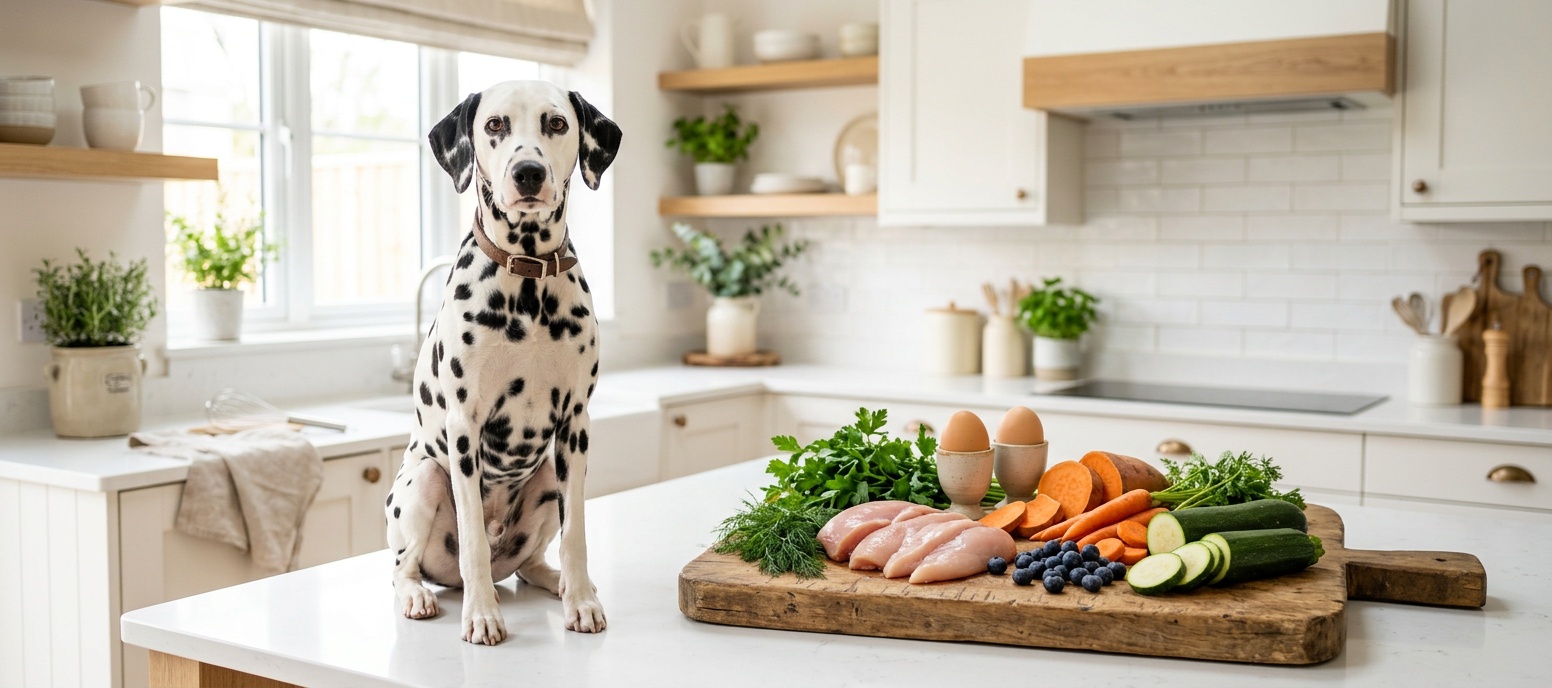
A while back, we looked after a Dalmatian (we'll call her J, to protect her privacy) while her owner was away. J was a beautiful, energetic girl, but from day one she had absolutely no interest in her kibble. She'd sniff it, walk away, and look at us like we'd personally offended her.
So we did what any curious person does: we started researching what Dalmatians actually like to eat, and whether there was something better we could offer her. That's when we first stumbled across the SLC2A9 gene, uric acid, and the whole world of low-purine feeding. We'd never heard any of it before. We'd already given her sardines as a treat, thinking we were doing something kind and healthy. Turns out that's one of the worst things you can give a Dalmatian.
We found out one day that J had developed kidney stones. It was one of those moments where everything we had just read suddenly felt very real.
Update, August 2026: J is staying with us again. She is older now, she has a stone history on her record, and everything below has stopped being background reading and started being the actual shopping list. Watching how carefully you have to read a label when your dog cannot process something most dogs handle without thinking is a different experience from reading about it.
That stuck with us. So many Dalmatian owners don't know about any of this until something goes wrong. We wanted to write it all down properly, so that the next person who Googles "why won't my Dalmatian eat her kibble" finds this page before they find the sardines.
⚡ Quick Answer
Dalmatians carry a unique gene mutation (SLC2A9) that stops them from processing purines the way other dogs can. Purines are found in high amounts in organ meats, sardines, anchovies and red meat. In Dalmatians they convert to uric acid, which builds up in the urine and forms painful stones. The solution is a low-purine diet built around chicken breast, turkey, eggs, cottage cheese and vegetables, combined with keeping your dog well hydrated.
The Gene That Makes Dalmatians Different
In most dogs, purines from food are broken down into a compound called allantoin, which is highly water-soluble and easily excreted in urine without causing problems. Dalmatians have a mutation in a gene called SLC2A9, which impairs the urate transporter in their kidneys and liver. Instead of converting uric acid into soluble allantoin, Dalmatians excrete uric acid directly, in concentrations up to five times higher than other breeds.
This condition is called hyperuricosuria (HUU). Unlike some breed predispositions that only affect a percentage of dogs, this one is universal: every Dalmatian carries it. The mutation became fixed in the breed through generations of selective breeding long before anyone understood what it was doing.
When uric acid builds up in concentrated urine, it crystallises. Those crystals can accumulate into stones (called urate uroliths) in the bladder or kidneys. Male Dalmatians are far more affected than females because their narrower urethra makes it harder to pass even small crystals. In serious cases a blockage can become a life-threatening emergency requiring surgery.
What Are Purines and Which Foods Are High in Them?
Purines are naturally occurring compounds found in the cells of all living things, plants and animals alike. When your dog eats food, the purines in that food are metabolised. In a normal dog this is fine. In a Dalmatian, the end-product (uric acid) accumulates instead of being cleared.
The problem isn't protein itself. It's the purine content within certain proteins. Organ meats are particularly problematic because they are essentially concentrated cell tissue, which means extremely high purine content. The foods to worry most about are:
- Organ meats: liver, kidney, heart, sweetbreads. These are the worst offenders. A single chicken liver serving can contain more purines than a whole day's worth of chicken breast.
- Small oily fish: anchovies, sardines, sprats, herring. Often used as healthy treats or meal toppers, these are extremely high in purines.
- Red meat: beef and lamb have moderate to high purine levels and should be limited rather than used as the daily protein base.
- Yeast and yeast extracts: nutritional yeast, Vegemite, Marmite, and some commercial dog supplements that use brewer's yeast.
Approximate Purine Content of Common Dog Foods (mg per 100g, lower is better for Dalmatians)
Values are approximate. Cooking method and cut affect final purine content. Organ meats and small oily fish are universally high regardless of preparation.
What to Feed a Dalmatian: The Safe Foods List
A well-balanced Dalmatian diet is absolutely achievable. It just means choosing proteins from the lower end of the purine scale and building the rest of the meal from low-purine carbohydrates and vegetables. Here's exactly what works:
| Food | Purine Level | Dalmatian Safe? | Notes |
|---|---|---|---|
| Chicken breast (skinless) | Low–Moderate | ✅ Yes | Ideal main protein. Breast is lower than thigh. |
| Turkey breast (skinless) | Low–Moderate | ✅ Yes | Excellent alternative to chicken. Great for variety. |
| Eggs | Very Low | ✅ Excellent | One of the best protein sources for Dalmatians. Scrambled, boiled or raw. |
| Cottage cheese / yoghurt | Very Low | ✅ Excellent | Good protein source and supports gut health. Plain, unsweetened only. |
| White rice / pasta | Very Low | ✅ Yes | Good carbohydrate base. Brown rice is slightly higher in purines. |
| Sweet potato, carrot, zucchini | Negligible | ✅ Yes | Vegetables are very low in purines. Excellent addition to any meal. |
| Beef / Lamb | Moderate–High | ⚠️ Limit | Not ideal as a daily protein. Use occasionally in small amounts. |
| Salmon / white fish | Moderate | ⚠️ Limit | Lower than oily fish. Occasional use is fine; not as a daily staple. |
| Organ meats (liver, kidney, heart) | Very High | ❌ Avoid | The single biggest dietary risk for Dalmatians. Even small amounts raise uric acid significantly. |
| Sardines / Anchovies / Herring | Very High | ❌ Avoid | Common in many dog diets as an omega-3 source, but too high in purines for Dalmatians. |
| Yeast / brewer's yeast | Extremely High | ❌ Avoid | Found in some supplements and commercial foods. Check labels carefully. |
The full list: high, moderate and low purine foods
The table above covers the foods that come up most often. This is the wider list, sorted into the three groups that actually matter when you are standing in a supermarket aisle reading an ingredients panel.
Organ meats
- Liver (all types)
- Kidney
- Heart
- Spleen
- Brain and sweetbreads
- Tripe
Oily fish & shellfish
- Anchovies
- Sardines and sprats
- Herring
- Mackerel
- Whitebait
- Mussels, scallops, prawns
Game meats
- Venison
- Duck and goose
- Rabbit
- Pheasant and other game birds
Yeast & concentrates
- Brewer's yeast
- Nutritional yeast
- Yeast extract spreads
- Meat extracts and gravy granules
- Fish meal (check kibble labels)
- Bone broth made with organ-rich bones
Meat
- Beef
- Lamb
- Pork
- Chicken thigh and dark meat
- Turkey dark meat
Fish
- Salmon
- Tuna
- Trout
- Cod and haddock
- Plaice
Grains & legumes
- Oats and oatmeal
- Barley
- Brown rice
- Wheat bran and wheat germ
- Wholemeal bread
- Peas, beans, lentils, chickpeas
- Soy products
Vegetables & nuts
- Spinach
- Asparagus
- Cauliflower
- Mushrooms
- Broccoli
- Peanuts
Best protein sources
- Eggs (whole, cooked)
- Cottage cheese
- Plain unsweetened yoghurt
- Milk and mild cheeses
- Chicken breast, skinless
- Turkey breast, skinless
Carbohydrates
- White rice
- Pasta
- Potato
- Sweet potato
- Tapioca
- White bread
Vegetables
- Carrot
- Courgette / zucchini
- Green beans
- Cucumber
- Pumpkin and squash
- Bell pepper
- Celery, cabbage, lettuce
- Beetroot
Fruit & fats
- Apple (seeds removed)
- Banana
- Blueberries
- Pear and melon
- Olive oil, coconut oil
An honest note on these numbers. There is no comprehensive purine database built specifically for dog food. The figures and groupings used here, and by most vets, are drawn from human food composition tables. They are a reliable guide to which foods are worse than others, but they are not precise measurements for your dog. Use them to make sensible choices, not to calculate to the milligram.
Why eggs and dairy do so much heavy lifting
One thing that surprises most owners: eggs, cottage cheese and plain yoghurt contain almost no purines at all, while still being complete, highly digestible protein. Every other protein source on this page carries at least some purine load. That is why low-purine feeding plans lean on eggs and dairy so heavily. It is not a fad, it is the only category that gives you real protein at close to zero purine cost.
This is also why "low purine" and "low protein" are not the same instruction. Your Dalmatian still needs plenty of good protein. You are changing where it comes from, not how much there is.
⚠️ Watch Out for These "Hidden" Purine Sources
Many owners are careful with main meals but get caught out by these:
- Fish-based kibble or wet food. Check the ingredients. Many premium dog foods use fish meal, anchovy or herring as a protein base. This makes them unsuitable for Dalmatians despite being "high quality."
- Organ meat treats. Freeze-dried liver treats, chicken heart chews and kidney snacks are popular but should be avoided entirely.
- Bone broth is the one that catches people out. It is genuinely good for most dogs, and you will find it recommended all over this site and every other dog nutrition site. Long-simmered marrow and joint bones concentrate purines into the liquid. If your Dalmatian has a stone history, treat bone broth as an occasional extra made from plain poultry carcass, not a daily addition.
- Our own recipes need adapting. A lot of the recipes on Breed-to-Bowl use liver, kelp, sardines or salmon oil because they are excellent for the average dog. For a Dalmatian they are not. If you are cooking from our recipe pages, swap the organ meat for extra egg, and talk to your vet about how to cover omega-3 without oily fish.
- Some vegetables. Spinach, asparagus and mushrooms have slightly elevated purines. Not dangerous, but if your dog has a history of stones, go easy on these.
Hydration: The Other Half of the Equation
Diet alone is not enough. The other critical factor in preventing urate stones is keeping your Dalmatian's urine well-diluted. Concentrated urine is where crystals form. The more water moving through the kidneys, the harder it is for uric acid to crystallise.
J, for what it's worth, was not a big water drinker. We noticed she'd barely touch her bowl unless she'd been running around. This is actually quite common in Dalmatians. For a breed that really needs to stay well flushed, a dog that ignores the water bowl is a real concern. If your Dalmatian is the same way, here's what actually helps:
How to get a water-reluctant Dalmatian to drink more
- Switch to wet food, or add water directly to dry food. This is the single most effective change you can make. A dog eating wet food passively takes in far more fluid than one eating kibble, without any effort on their part. If they're refusing kibble anyway (like J was), this is an easy win.
- Add low-purine broth to meals. A splash of plain chicken broth, made from carcass rather than organs, makes food far more appealing and dramatically increases fluid intake. Most dogs who ignore water will lap up broth-soaked food without hesitation.
- Try a running water fountain. Many dogs refuse still water but drink readily from a pet water fountain. The movement keeps it oxygenated and cooler, which dogs prefer. Several owners of water-reluctant Dalmatians swear by these.
- Multiple bowls in different locations. A dog is more likely to drink if they encounter water often throughout the day: near the sofa, near their bed, near the back door. Out of sight, out of mind applies to water bowls too.
- Ice cubes as a treat. Some dogs who won't drink will happily crunch ice. It's water in disguise.
- Check the bowl itself. Some dogs dislike plastic bowls (which can retain odours) and prefer stainless steel or ceramic. A simple swap sometimes makes a surprising difference.
Monitor urine colour as a simple daily check. Pale straw is ideal, dark yellow means they need more water. For a Dalmatian, dark urine is a warning sign worth taking seriously.
Urine pH: The Part Most Owners Never Hear About
Water is half the story. The other half is how acidic the urine is. Urate dissolves far more readily in alkaline urine than acidic urine, which is why veterinary protocols for dissolving existing stones aim for a urine pH above 7. At that point the chemistry starts working with you instead of against you.
The medication vets most commonly reach for is potassium citrate, given alongside a low-purine diet. You may also see sodium bicarbonate mentioned in older articles and forum posts, including in earlier versions of this page. Potassium citrate is the standard in current veterinary guidance, and either way the dose has to be worked out for your individual dog and then checked with repeat urine tests.
You can buy urine pH test strips cheaply and check at home between vet visits. Catching first-morning urine gives the most consistent reading, since pH naturally rises after meals. Bring the numbers to your appointment. It is genuinely useful information for your vet and it costs you almost nothing.
⚠️ Do not try to alkalise your dog's urine on your own
This is one place where guessing does real harm. Pushing urine too far in either direction can encourage a completely different type of stone to form, and some dogs with heart or kidney conditions should not be given extra potassium or sodium at all. Test at home if you like, but let your vet set the dose.
How to Check for Signs of Stones
Urate crystals can be building for months before anything looks wrong. Some dogs give you clear early warnings. Others show nothing at all until a stone is large enough to cause trouble, which is exactly why the routine urine test further down this page matters so much.
Early signs worth acting on
None of these on their own means stones. Together, or persisting for more than a day or two, they are a reason to book a vet appointment rather than wait and see.
- Straining, or taking noticeably longer than usual to start. Watch how long they stand in position before anything happens.
- Lots of small wees instead of one long one. A dog that used to empty in one go and now stops at six lamp posts is telling you something.
- Pink, red, orange or cloudy urine. Easiest to spot on snow, pale paving or a light towel. Blood is often only visible at the very end of the stream.
- Licking the genital area more than normal.
- Accidents indoors from a dog who has been reliably clean for years. This is discomfort and urgency, not bad behaviour, and telling them off is both unfair and unhelpful.
- Restlessness at night, pacing, repeated trips to the garden that produce very little.
- Flinching or tensing when you touch their lower belly.
- Urine that suddenly smells much stronger than usual.
A simple weekly habit
Once a week, actually watch your Dalmatian urinate rather than looking at your phone. You are checking three things: how long it takes them to start, whether the stream is steady or stop-start, and what colour it is. Thirty seconds of attention, and it is the single most reliable early-warning system you have. Pale straw colour and a steady stream is what you want.
🚨 When it becomes an emergency: stop reading and phone the vet
A stone that moves into the urethra can block it completely. This is the situation that kills Dalmatians, and it can go from uncomfortable to critical inside a day. Male dogs are at much higher risk because their urethra is narrower and it narrows further as it passes over the pelvis, so a stone that would pass harmlessly in a female gets stuck.
Treat any of these as an emergency, at any hour:
- Straining repeatedly and producing nothing, or only a few drops
- Crying, yelping or looking distressed while trying to go
- A hard, swollen or clearly painful belly
- Vomiting, refusing food, unusual lethargy, or collapse
- No urine passed at all for 12 hours or more
Why the hurry. When urine cannot leave the body, pressure backs up into the kidneys and waste products build in the bloodstream. The bladder can rupture. Dogs become critically unwell quickly, and by the time they look really sick a lot of damage has already been done.
Phone your vet or the nearest emergency clinic straight away. Do not wait until morning, do not wait to see if it settles, and do not try to fix it at home with water, food or supplements. If you are wrong, you have paid for one consultation. If you are right and you waited, you may not get another chance.
What Your Vet Will Actually Do
Knowing roughly what to expect makes the appointment much less frightening, and it helps you ask better questions.
Work out what kind of stone it is
This matters because different stones need different treatment. Urate stones are often harder to see on a plain X-ray than other stone types, so your vet may reach for ultrasound instead. If a Dalmatian is not involved and urate stones turn up in a breed with no known predisposition, good vets also check for a liver shunt, because that is the other main cause of urate stones in dogs.
Try to dissolve them before operating
Urate is one of the few stone types that can sometimes be dissolved rather than cut out. The protocol combines three things: a strict low-purine diet, raising urine pH above 7, and getting far more water through the system. In Dalmatians this works roughly half the time, usually within about a month, according to the MSD Veterinary Manual. Half is not brilliant odds, but it is a genuine chance to avoid surgery.
Possibly add allopurinol
Allopurinol reduces uric acid production and is often added during dissolution. There is an important catch that owners are not always told: it must be paired with a genuinely strict low-purine diet. If your dog keeps eating purines while on allopurinol, they can form xanthine stones instead, and you have simply swapped one problem for another.
Remove them if dissolution fails
Options include surgery, a non-surgical technique called voiding urohydropropulsion for stones small enough to flush out, and laser lithotripsy at some referral centres. A blocked dog needs the blockage relieved urgently regardless of the longer-term plan.
Keep checking, because they come back
This is the part to make peace with. Urate stones recur often in dogs with hyperuricosuria. Prevention is lifelong rather than a course of treatment you finish. Periodic imaging catches new stones while they are still small enough to deal with easily, which is far better than discovering them when one blocks.
💡 Annual urine testing is worth it
For Dalmatians, an annual urinalysis, a simple and inexpensive urine test your vet can run, is one of the best investments you can make. It checks for crystals, pH, and early signs of stone formation before they become a problem. If you're feeding a homemade diet, ask your vet to check uric acid levels specifically. Catching this early means a diet tweak, not surgery.
A Note on LUA Dalmatians
Since the 1970s, a small group of breeders have been running the Dalmatian-Pointer Backcross Project, introducing the normal SLC2A9 allele from Pointer dogs back into Dalmatian lines to create what are called LUA (Low Uric Acid) Dalmatians. These dogs metabolise purines normally and are not at the same dietary risk.
The AKC began registering LUA Dalmatians in 2011. If you're getting a puppy, it's worth asking the breeder whether the parents have been tested as LUA. If you already have a Dalmatian and aren't sure, the HUU genetic test is available from labs like the UC Davis Veterinary Genetics Laboratory and Orivet (Australia/Asia).
⚠️ This is a guide, not a treatment plan
Urate stones are a medical condition and this article is not a substitute for veterinary diagnosis or treatment. If your Dalmatian has stones, or you suspect they might, work with your vet on the plan rather than changing the diet on your own. Dissolution protocols, allopurinol and any medication that alters urine pH all need proper dosing and follow-up testing.
If you are moving to a fully homemade diet for the long term, a low-purine plan built at home can easily end up short on nutrients, because you are removing several of the ingredients most commonly used to cover them. A board-certified veterinary nutritionist (DACVN) can formulate something that is both low in purines and complete. That is worth doing properly.
🐾 Want a Dalmatian-Safe Recipe?
Our recipe generator lets you build breed-specific, low-purine meals using chicken breast, turkey, eggs and vegetables, with the right nutritional balance for your dog's size and age.
Build a Dalmatian Recipe →📚 Sources & Further Reading
- Bannasch, D.L. et al. (2008). Mutations in the SLC2A9 gene cause hyperuricosuria and hyperuricemia in the dog. PLoS Genetics. PubMed →
- Karmi, N. et al. (2010). Estimated frequency of the canine hyperuricosuria mutation in different dog breeds. Journal of Veterinary Internal Medicine. PubMed →
- Albasan, H. et al. (2005). Evaluation of the association between sex and risk of forming urate uroliths in Dalmatians. Journal of the American Veterinary Medical Association. PubMed →
- Bartges, J.W. & Callens, A.J. (2015). Urolithiasis. Veterinary Clinics of North America: Small Animal Practice, 45(4):747–768. PubMed →
- Van Vertloo, L. (2026). Urolithiasis in Dogs (Urate Stones section). MSD Veterinary Manual. msdvetmanual.com →
- Lulich, J.P. et al. (2016). ACVIM Small Animal Consensus Recommendations on the Treatment and Prevention of Uroliths in Dogs and Cats. Journal of Veterinary Internal Medicine, 30(5):1564–1574. PMC →
- UC Davis Veterinary Genetics Laboratory. Hyperuricosuria (HUU) testing in dogs. vgl.ucdavis.edu →