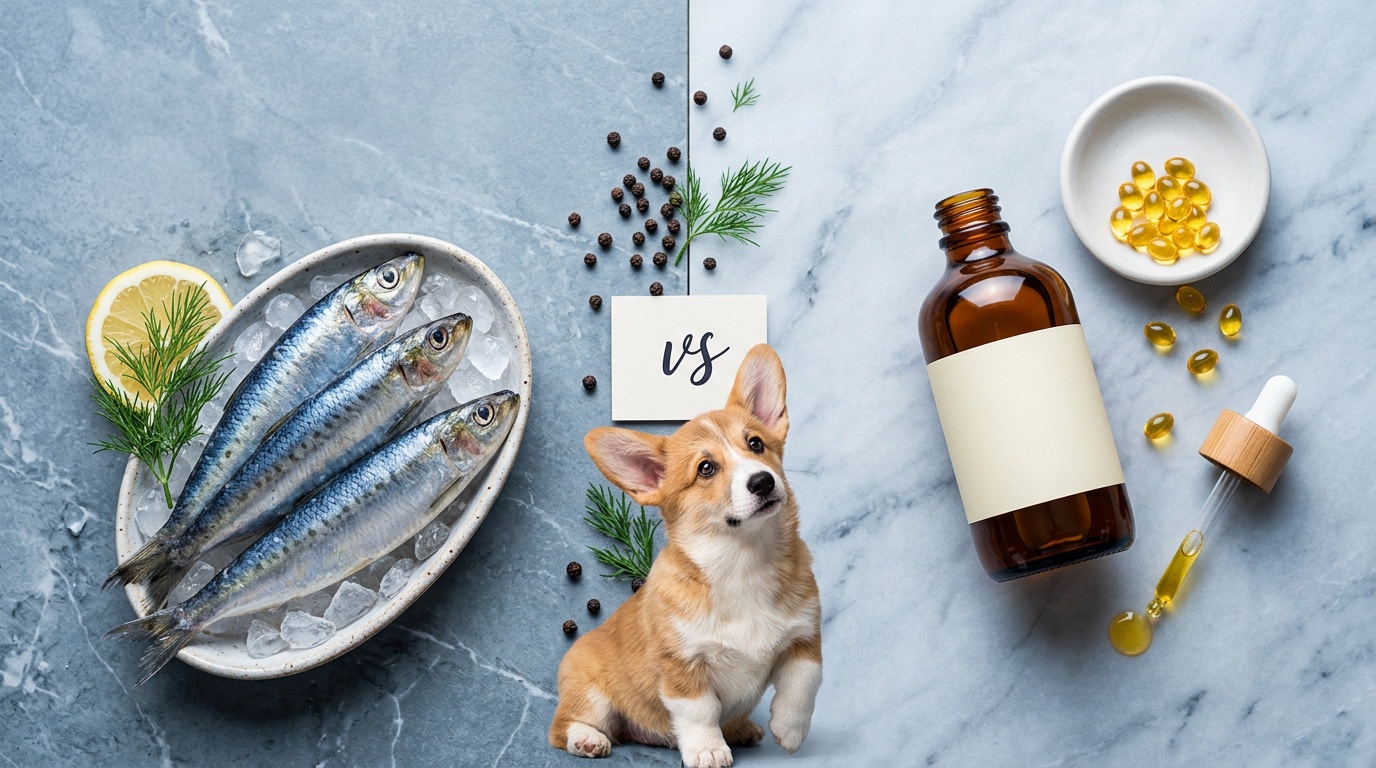
🐟 Nutrition Deep-Dive
Both are good omega-3 sources. But they are not equal — and for most dogs eating homemade food, one is a significantly smarter buy.
If you cook homemade food for your dog, you probably already know that omega-3 needs to be topped up. Most recipes are naturally high in omega-6 (from meat fat, eggs, and grains) and short on omega-3, and that imbalance matters over time. The two most popular fixes are salmon oil and sardines. This post explains exactly what each one does, what the science says, and which is the better value for most owners.
Whole sardines in spring water deliver more omega-3 per serving than most salmon oil products, cost less, and come with meaningful bonus nutrition — protein, calcium, vitamin D, and B12 — that salmon oil simply does not have. If you are choosing one, sardines are usually the better buy. If you already use sardines, you do not need salmon oil on top.
Dogs need two specific omega-3 fatty acids: DHA (docosahexaenoic acid) and EPA (eicosapentaenoic acid). DHA supports brain and eye development, especially in puppies and seniors. EPA is the anti-inflammatory one — it helps with joints, skin, coat condition, and reducing the low-grade chronic inflammation that builds up in dogs eating unbalanced homemade diets over months and years.
The National Research Council (NRC) recommends a minimum of around 0.11g of EPA+DHA combined per 1,000 kcal of food for adult dogs. For a 20kg dog eating roughly 1,200 kcal per day, that works out to about 130mg of EPA+DHA daily. Most dogs eating meat-heavy homemade food without any fish supplementation are well short of that.
Flaxseed oil, chia seeds, and walnuts all contain ALA (alpha-linolenic acid), which is technically an omega-3. But dogs convert ALA to DHA and EPA very poorly — conversion rates are under 10% in most studies. You cannot reliably meet a dog's DHA and EPA needs with plant sources. Marine-based omega-3 from fish is the only practical way to supplement a homemade diet.
Salmon oil is a concentrated extract of fat from salmon, with essentially everything else removed. One teaspoon (about 5ml) of a decent salmon oil typically delivers 1,000–1,500mg of combined EPA and DHA. It is odourless compared to whole fish, easy to measure, and has a long shelf life once you find a brand you trust.
The limitation is that salmon oil is only oil. It adds omega-3 fats and nothing else. There is no protein, no calcium, no vitamins — just the fatty acid profile. It does that job well, but it is doing exactly one thing.
⚠️ Critical rule for salmon oil: Never add salmon oil during cooking. Heat oxidises omega-3 fatty acids and renders them useless — or worse, turns them into harmful free radicals. Always stir salmon oil into the bowl cold, right before serving. This applies to any fish oil supplement, including sardine oil and cod liver oil.
A standard 90g tin of sardines in spring water contains roughly 2–3g of EPA+DHA omega-3 — often twice the amount in a teaspoon of salmon oil. But that is only the beginning of what you get. Whole sardines also deliver around 18–22g of protein per tin, significant calcium from the soft edible bones, vitamin D, vitamin B12, selenium, and phosphorus. You are not adding a supplement; you are adding a whole food with a strong nutritional profile.
The key is buying sardines in spring water, not brine and not sunflower oil. Brine versions are far too high in sodium for dogs. Sardines packed in sunflower or soya oil are adding mostly omega-6, which is the opposite of what you want. Spring water only. Rinse briefly before serving if you are not sure.
A 90g tin of sardines in spring water typically costs roughly $1.50–$2.50 and provides two or three servings for a medium dog. A quality salmon oil (Grizzly, Nordic Naturals, Rosie's Farm) costs $30–$50 for 200ml and lasts about four to six weeks for a 20kg dog. Per milligram of EPA+DHA delivered, sardines work out considerably cheaper in most markets worldwide.
| Factor | 🐟 Tinned Sardines (in spring water) |
🫙 Salmon Oil | Winner |
|---|---|---|---|
| EPA + DHA per serve | ~2,000–3,000mg per 90g tin | ~1,000–1,500mg per tsp | 🐟 Sardines |
| Cost per serve | ~$0.50–1.00 | ~$0.80–1.50 | 🐟 Sardines |
| Protein | ~20g per tin | Zero | 🐟 Sardines |
| Calcium | Good — from soft bones | None | 🐟 Sardines |
| Vitamin D & B12 | Present | Trace only | 🐟 Sardines |
| Convenience for batch cooking | Needs to be added cold, separately | Easy drizzle after cooking | 🫙 Salmon Oil |
| Shelf life (once opened) | Refrigerate, use within 2 days | Refrigerate, use within 2–3 months | 🫙 Salmon Oil |
| Picky eater compatibility | Strong smell — some dogs resist | Milder smell | 🫙 Salmon Oil |
| Overall nutrition value | Whole food — fat + protein + vitamins | Fat supplement only | 🐟 Sardines |
No. If you include sardines in your dog's meals a few times a week, the omega-3 requirement is covered without needing any additional oil. Buying both is not wrong, but it is unnecessary spending. Pick one and use it consistently.
The one scenario where salmon oil genuinely earns its place alongside sardines is batch cooking. If you cook a large batch of food, portion it, and freeze it — then serve individual bowls throughout the week — adding sardines to each bowl means either freezing them in (not ideal for omega-3) or opening a fresh tin every time you serve. Salmon oil is easier here: you thaw the bowl and stir in a teaspoon of oil cold before handing it over. Some owners keep sardines for fresh meal days and salmon oil for batch-cook days. That is a perfectly sensible approach.
The rule of thumb: If your dog eats fresh meals — sardines. If your dog eats mostly batch-cooked and frozen meals — salmon oil added cold to each serving. Either way, you need one, not both.
Use sardines in spring water only. Drain the tin, rinse if you like, and serve whole, mashed, or flaked through the bowl. For a 10–15kg dog, half a tin (about 45g) two or three times a week gives a solid omega-3 contribution without overdoing the fish content. For a larger dog over 25kg, a full tin two or three times a week is appropriate. You do not need to serve fish every single day — spreading it across the week is fine.
Add sardines cold, after cooking, mixed directly into the bowl just before serving. Never cook them with the rest of the batch if you want to preserve the omega-3.
Other small oily fish work on the same principle — mackerel, herring, and anchovies are all valid alternatives. The same rules apply: spring water, not brine, added cold.
Store the bottle in the fridge from the day you open it, and use it within two to three months. A good starting dose for most dogs is around half a teaspoon per 10kg of body weight per day — so a 20kg dog gets about a teaspoon. Start low and build up over a week or two; some dogs get loose stools if you introduce too much fat at once.
Check that your salmon oil is actually salmon oil, not a blend of cheaper vegetable oils with fish added. The ingredient list should be simple: salmon oil, possibly with a vitamin E stabiliser. If the ingredient list is long, find a different product.
Not as a substitute, no. Flaxseed oil contains ALA, a plant-based omega-3. Dogs convert it to DHA and EPA so poorly that you cannot realistically meet their needs this way. Flaxseed oil has other benefits for skin and coat, but it is not a replacement for marine omega-3.
Try mashing them well into the food rather than serving them whole. Most dogs who initially refuse sardines will accept them once the smell is less obvious. If they still refuse after a few tries, switch to salmon oil — some dogs simply do not tolerate strong fish flavours.
Cod liver oil does contain DHA and EPA, but it also contains very high levels of vitamins A and D. These vitamins are fat-soluble and accumulate in the body over time, so excess can cause toxicity. Salmon oil is a safer daily supplement. If you use cod liver oil, keep the dose low and do not use it every day.
Yes. Fresh salmon as a main protein source covers omega-3 fully — no additional oil or fish supplement is needed when salmon features in the recipe. This is why our Norwegian Salmon Soup recipe, for example, uses a "complete" callout rather than adding salmon oil separately.
Not greatly. Most supermarket brands of sardines in spring water are fine — John West, King Oscar, and similar widely available tins all work well. The species (Atlantic or Pacific sardine) makes little practical difference. What matters most is the packing medium: spring water only, every time.
Daily is ideal if your dog eats homemade food regularly. A teaspoon of salmon oil per day for a medium dog, or a few sardine servings spread across the week, keeps EPA and DHA at good levels. Skipping it occasionally is not a crisis, but making it a consistent habit is what actually produces the coat, joint, and inflammatory benefits you are aiming for.
For most people feeding homemade dog food, sardines in spring water are the better choice — more omega-3, more total nutrition, and lower cost per serving. The only areas where salmon oil has a genuine advantage are convenience for batch cooking, shelf life, and palatability for fussy dogs.
You do not need both. Pick the one that fits your feeding routine, use it consistently, and always add it cold after cooking. That single habit — cold omega-3 added at serving — does more for your dog's long-term health than most supplements people spend money on.
Browse recipes that already have the omega-3 sorted — with sardines built in or salmon oil in the sidebar.
Explore Recipes →