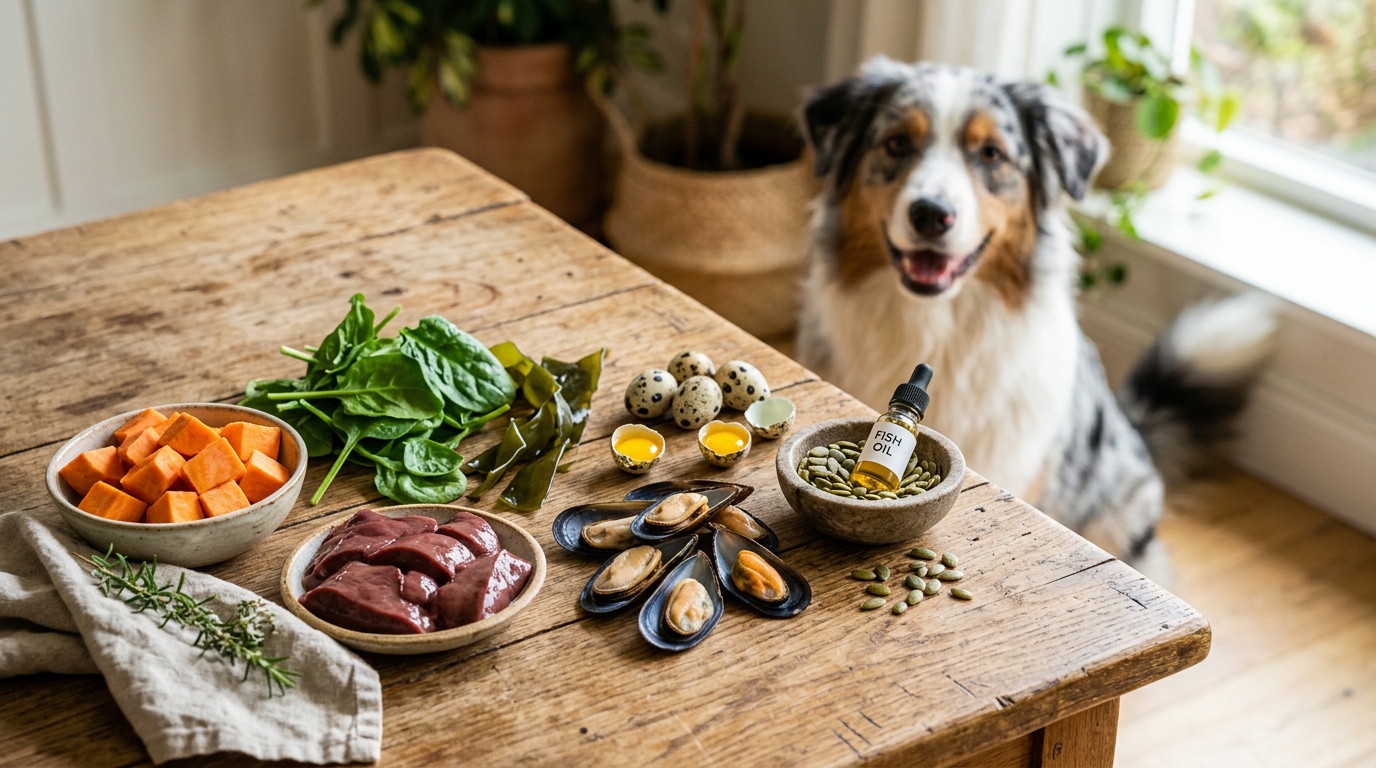
The most common objection to homemade dog food is that it can't be nutritionally complete. And in one sense, that objection is right: a bowl of plain chicken and rice, served every day, will develop deficiencies over time. But "homemade food has gaps" and "those gaps can't be filled" are two very different claims. The gaps are real. The inability to fill them is not.
This is a reference page. It lists the 13 nutrients most commonly deficient in homemade diets, maps each one to its best whole-food sources, and explains how to work them into a real meal. It covers both raw and cooked preparation — because the answer to "where does my dog get iodine?" should not depend on whether you cook your food or not.
How to use this page: If you're building a new recipe from scratch, read it all. If you're checking a specific nutrient your vet flagged, jump straight to that section. The quick-reference table at the bottom lets you scan everything at once. Amounts given are approximate and based on NRC 2006 guidelines for an average adult dog — adjust proportionally for your dog's size and activity level.
EPA and DHA are the long-chain omega-3 fatty acids — the ones that actually do the work. They're the reason salmon is good for dogs (and for us). Most homemade diets are naturally high in omega-6 from chicken fat and plant oils, which drives inflammation when omega-3 is too low. The fix is simple once you know where to look.
One important distinction: ALA — the plant version of omega-3 found in flaxseeds and chia — is not a useful source of EPA or DHA for dogs. The conversion rate from ALA to EPA/DHA in dogs is poor. For this, you need fish.
Best whole-food sources
Atlantic mackerel (canned/fresh)~2.5g EPA+DHA per 100ghighest density, easy to find
Sardines in water (canned)~1.5g EPA+DHA per 100gbones included = bonus calcium
Fresh salmon~1.8–2.2g EPA+DHA per 100galso provides vitamin D
Herring / pilchard~1.6g EPA+DHA per 100goften cheaper than salmon
Salmon oil / sardine oil (supplement)~800–1000mg EPA+DHA per tspadd cold after cooking
How to add: 1–2 sardines or a 50g portion of canned mackerel 3–4× per week for a medium dog. If using oil, add 1 tsp per meal after the food has cooled — heat destroys omega-3.
Vitamin D is the nutrient most reliably deficient in homemade meat-based diets. Unlike humans, dogs cannot synthesise meaningful amounts of vitamin D through sun exposure — they need it from food. Muscle meat contains almost none. Without deliberate planning, a homemade diet built around chicken breast, beef mince, and vegetables will likely be vitamin D deficient within weeks.
The best whole-food sources are oily fish and beef liver. Rotating a fish-based meal into the weekly plan 2–3 times is the most practical way to cover this without supplementing.
Best whole-food sources
Fresh salmon~500–600 IU per 100gone of the best sources available
Atlantic mackerel~360 IU per 100g
Canned sardines in water~272 IU per 100geasy weekly rotation
Beef liver~49 IU per 100galso provides copper, zinc, B12, vitamin A
Whole eggs~82 IU per 100guseful but not sufficient alone
How to add: Rotate one fish-based meal per week (salmon, sardines, or mackerel). For non-fish weeks, add 15–20g of diced beef liver to the pot 2–3× per week — this alone provides useful vitamin D alongside copper, B12, and zinc.
Iodine is almost entirely absent from standard homemade ingredients. Chicken, beef, pork, rice, sweet potato, carrots — all contain negligible amounts. Without a deliberate source, a homemade diet will be iodine deficient, and hypothyroidism is the long-term consequence. The fix is extremely simple: a small amount of kelp powder added to every meal.
Best whole-food sources
Kelp powder~280–400 mcg per ⅛ tspeasiest daily solution — don't exceed dose
Nori seaweed (dried sheets)~37 mcg per sheet (2.5g)crumble over food
Blue mussels~130 mcg per 100galso high in manganese and zinc
Canned salmon with bones~20–30 mcg per 100gminor contribution
How to add: ⅛ tsp kelp powder per meal for a 15–25kg dog. Kelp is very dense — more is not better. Sprinkle nori crumbles if you prefer a whole-food approach. Both work for raw or cooked diets.
Vitamin E is the main fat-soluble antioxidant protecting cell membranes — and it's one of the first nutrients to go deficient in high-fat homemade diets. This is slightly counterintuitive: the more fat in the diet, the more vitamin E is needed to protect it. Fish-rich or raw diets with lots of oily meat are particularly prone to this gap because polyunsaturated fats oxidise easily and require antioxidant protection.
The richest whole-food source is wheat germ oil, which contains more vitamin E per gram than almost anything. The key rule: always add it cold. Heat destroys vitamin E rapidly.
Best whole-food sources
Wheat germ oil~20mg vitamin E per 1 tbsp (15ml)add cold after cooking
Sunflower seeds (raw)~26mg per 100ggrind before adding for absorption
Sunflower oil~5.6mg per 1 tbspfar less concentrated than wheat germ oil
Almonds~25mg per 100gfine in small amounts, ground
How to add: 1 tsp wheat germ oil stirred in after cooking, per meal. Store in the fridge and use within 3 months of opening.
Zinc deficiency in dogs shows up most visibly in the coat and skin — rough, flaky, or dull fur is a common early sign. Some breeds are more vulnerable than others: Northern breeds like Siberian Huskies and Alaskan Malamutes have a known predisposition to zinc-responsive dermatosis, where even a technically adequate dietary intake may not be enough. The absorption point matters too: zinc from plant sources is significantly less bioavailable than zinc from animal tissue, because phytates in plants bind to zinc and reduce uptake.
Best whole-food sources
Oysters~76mg per 100gby far the richest source of any food
Beef (muscle meat)~4–5mg per 100gwell-absorbed heme zinc
Pumpkin seeds (raw)~7.5mg per 100gserve raw or lightly ground
Beef liver~5.2mg per 100gmoderate but well-absorbed
Lamb~4.5mg per 100g
How to add: 1 tsp raw pumpkin seeds per meal (ground or whole for large dogs). Oysters once or twice a week is the most concentrated option. Beef-based diets are naturally better for zinc than chicken-based ones.
Manganese is one of the nutrients that muscle meat simply doesn't deliver well. Chicken, beef, and pork muscle are all low in manganese, which means a diet built around those proteins without any shellfish, seeds, or green tripe will often fall short. It's particularly important for growing dogs and joint-health-focused diets, where manganese plays a role in cartilage synthesis.
Best whole-food sources
Blue mussels~3.4mg per 100galso covers zinc, iodine, and B12
Pumpkin seeds (raw)~2.1mg per 100galso covers zinc and magnesium
Green tripe~1.2–1.8mg per 100graw diet mainstay
Spinach / leafy greens~0.9mg per 100glightly cooked for better uptake
How to add: 1 tsp raw pumpkin seeds daily covers a meaningful portion of manganese needs alongside zinc and magnesium. Mussels once a week are excellent for dogs that tolerate shellfish.
Magnesium tends to be overlooked because muscle meat provides a reasonable amount — it's not the gaping hole that iodine or vitamin D are. But high-protein, high-fat diets without any seeds, fish, or green vegetables can still fall short. Magnesium is involved in so many metabolic reactions that chronic mild deficiency is hard to pinpoint clinically, which is partly why it gets missed.
Best whole-food sources
Pumpkin seeds (raw)~168mg per 100gvery high — 1 tsp delivers ~20mg
Sardines in water~39mg per 100g
Green tripe~20–30mg per 100g
Leafy greens (spinach, kale)~50–80mg per 100g rawlightly steam to reduce oxalates
How to add: If you're already adding 1 tsp raw pumpkin seeds and rotating sardines weekly, magnesium is likely covered. No separate step needed.
This is the one that makes vets most nervous about homemade diets — and with good reason. Meat is naturally high in phosphorus and almost entirely lacking in calcium. Dogs need a calcium-to-phosphorus ratio close to 1.2–1.4:1 in the diet. A plain meat-and-vegetable bowl without any calcium source will have a ratio closer to 1:15 or worse. Over time, the body compensates by pulling calcium from bones.
The practical fix is one of the simplest in homemade dog nutrition: eggshell calcium powder. A quarter teaspoon of dried, ground eggshell provides approximately 400mg of calcium — enough to correct the balance in a medium-sized dog's meal.
Best whole-food sources
Eggshell powder (dried, ground)~400mg calcium per ¼ tspeasiest and cheapest option for cooked diets
Raw meaty bonesHighly variable — 50–200mg per 100graw diets only, never cooked bones
Canned sardines/salmon with bones~380mg per 100gbones are soft and edible — excellent source
Plain yoghurt / kefir~110–120mg per 100guseful but not sufficient as sole source
Note on cooked bones: Cooked bones splinter and are dangerous. For cooked diets, use eggshell powder or canned fish with soft bones. Raw meaty bones are the standard solution for raw diets.
How to add: ¼ tsp eggshell powder per meal for a 10–15kg dog, added after cooking. Scale up for larger dogs. Make your own by drying egg shells in the oven at 150°C for 10 minutes, then grinding to a powder.
The critical distinction here is between retinol (true vitamin A, from animal sources) and beta-carotene (the plant precursor found in carrots, pumpkin, and leafy greens). Dogs convert beta-carotene to retinol very inefficiently — far less so than humans. Feeding your dog carrots for vitamin A, as some guides suggest, doesn't reliably work. The only meaningful dietary source of retinol for dogs is animal liver.
The complication is that liver is also extremely rich in vitamin A, so too much too often can cause toxicity over time. The sweet spot is feeding beef or chicken liver 2–3 times per week in small amounts — not daily, and not in large portions.
Best whole-food sources
Beef liver~4,968 mcg retinol per 100gextremely high — limit to 15–20g per serving, 2–3× per week
Chicken liver~3,296 mcg retinol per 100gslightly lower — same frequency rules apply
Pork liver~6,502 mcg retinol per 100ghighest of the common livers — use sparingly
Vitamin A toxicity is real. It accumulates in fat tissue and is not easily excreted. Feeding liver every single day for months or years can cause hypervitaminosis A — a serious condition. Stick to 10–20g of liver, 2–3 times per week, and you'll be fine.
How to add: Dice and add 15–20g of beef or chicken liver to the pot 2–3× per week. This one ingredient also covers copper, B12, zinc, vitamin D, and iron — arguably the single most nutritionally dense food you can add to a homemade diet.
Most meat-based homemade diets cover iron reasonably well — red meat is a solid source. The issue is typically either a chicken-only diet (chicken is lower in iron than beef or lamb) or over-reliance on plant sources. Plant iron (non-heme iron) is poorly absorbed by dogs. A diet heavy in vegetables and light on red meat or organ meat can end up iron-low despite technically containing iron.
Best whole-food sources
Beef spleen~33mg per 100gexceptional — if you can source it
Beef liver~6.5mg per 100gheme iron — very well absorbed
Beef / lamb muscle meat~2.5–3.5mg per 100greliable daily contribution
Beef heart~6mg per 100gtechnically muscle — excellent iron source
How to add: Include red meat (beef, lamb) as the base protein at least a few times per week. Adding beef liver 2–3× per week as part of your vitamin A/D routine also handles iron at the same time.
B12 is found almost exclusively in animal products, so any meat-based homemade diet will naturally have some. The issue tends to arise in diets that are very lean and muscle-meat-only — particularly chicken breast without any organ meat or fish. Liver is astronomically high in B12, to the point that adding it 2–3 times per week essentially handles this nutrient entirely.
Best whole-food sources
Beef liver~83 mcg per 100gextremely high — far above daily needs
Clams / mussels~49–98 mcg per 100ghighest density of any food
Sardines (canned)~8.9 mcg per 100g
Beef heart~7.4 mcg per 100g
Beef muscle meat~2–3 mcg per 100gmodest but daily
How to add: If you're already rotating liver 2–3× per week, B12 is covered many times over. No additional action needed for most homemade diets that include any organ meat.
Copper and iron are deeply linked — copper is required for the body to properly use iron, so a copper deficiency can look a lot like anaemia even when iron intake is adequate. The good news: beef liver solves this one too. The complication: certain breeds — Bedlington Terriers, Doberman Pinschers, West Highland White Terriers, and Labrador Retrievers to some degree — have genetic variants that cause copper to accumulate in the liver rather than being properly excreted. For these breeds, limiting liver and avoiding supplemental copper is important.
Best whole-food sources
Beef liver~9.8mg per 100gby far the richest source
Oysters~7.6mg per 100g
Beef heart~0.4mg per 100gmoderate contribution
How to add: Liver 2–3× per week is sufficient. If you have a copper-storing breed, discuss with your vet before routinely including liver.
Thiamin is usually adequate in balanced meat-based diets, but there's one specific risk worth knowing: raw freshwater fish contains thiaminase, an enzyme that destroys thiamin. If your dog's raw diet includes significant amounts of raw carp, trout, or other freshwater fish fed frequently, thiamin deficiency is a genuine concern over time. Saltwater fish (sardines, salmon, mackerel) are fine. The other risk is high-heat cooking, which degrades thiamin significantly — it's one of the more heat-sensitive B vitamins.
Best whole-food sources
Pork (loin, shoulder)~0.8mg per 100gone of the best food sources available
Nutritional yeast~10–15mg per 100gvery high — use 1 tsp per meal
Beef heart~0.5mg per 100g
Sunflower seeds~1.5mg per 100galso provides vitamin E
How to add: Rotating pork into the weekly menu handles this naturally. If cooking on high heat regularly, consider adding 1 tsp nutritional yeast to the finished bowl a few times per week.
Quick Reference: All 13 Nutrients at a Glance
If you want a single view of everything above — the nutrient, the top source, and the practical action — here it is.
| Nutrient |
Top whole-food source |
What to do |
Both raw & cooked? |
| EPA + DHA | Mackerel, sardines, salmon | Rotate fish 2–3× per week, or add 1 tsp salmon oil cold | Yes |
| Vitamin D | Fresh salmon, mackerel | Weekly fish rotation + liver 2–3× per week | Yes |
| Iodine | Kelp powder, nori | ⅛ tsp kelp per meal — every meal | Yes |
| Vitamin E | Wheat germ oil | 1 tsp stirred in cold after cooking | Yes (cold only) |
| Zinc | Oysters, beef, pumpkin seeds | 1 tsp raw pumpkin seeds daily + beef-based protein | Yes |
| Manganese | Mussels, pumpkin seeds | 1 tsp raw pumpkin seeds covers most of this | Yes |
| Magnesium | Pumpkin seeds, sardines | Covered by pumpkin seeds + fish rotation | Yes |
| Calcium | Eggshell powder, sardines with bones | ¼ tsp eggshell powder per meal (cooked) or raw bones (raw) | Varies by prep |
| Vitamin A | Beef liver | 15–20g beef liver, 2–3× per week — never daily | Yes |
| Iron | Beef spleen, beef liver, red meat | Red meat base protein + liver rotation handles this | Yes |
| Vitamin B12 | Beef liver, clams | Covered by liver rotation — nothing extra needed | Yes |
| Copper | Beef liver, oysters | Covered by liver rotation — check breed predispositions | Yes |
| Thiamin (B1) | Pork, nutritional yeast | Rotate pork into the weekly menu | Yes (avoid raw freshwater fish) |
What This Looks Like in Practice
If you look at the table above, you'll notice that a lot of nutrients get solved by the same few ingredients. Beef liver handles vitamin A, vitamin D, copper, B12, zinc, and iron in one go — and it needs to be fed only 2–3 times per week in small amounts. Pumpkin seeds handle zinc, manganese, and magnesium. Kelp handles iodine. Wheat germ oil handles vitamin E. Eggshell powder handles calcium. That's five deliberate additions that close nearly every gap a homemade diet can have.
At Breed-to-Bowl, these aren't optional extras — they're built into every recipe we publish. Here's what we include in every main-meal recipe:
🐟 Salmon / sardine oil
1 tsp per meal, added cold
Covers: EPA + DHA. Add after the food cools — heat destroys omega-3.
🌿 Kelp powder
⅛ tsp per meal
Covers: Iodine. The single most commonly missed mineral in homemade diets.
🌾 Wheat germ oil
1 tsp per meal, added cold
Covers: Vitamin E. Always add cold — do not cook with it.
🥚 Eggshell calcium powder
¼ tsp per meal, added cold
Covers: Calcium. Corrects the Ca:P imbalance in all meat-heavy diets.
🎃 Raw pumpkin seeds
1 tsp per meal
Covers: Zinc, manganese, magnesium. Raw or lightly ground — don't cook them.
The one thing this page can't do is tell you whether your specific dog's diet is complete. The nutrients above are the most commonly deficient — but completeness depends on how much you're feeding, which proteins you're rotating, and your dog's individual health status. If you've been feeding homemade food for a long time and haven't had bloodwork done recently, a routine panel is always worth doing.
Try Our Recipe Generator
All our recipes are built to include these five nutrients as standard. Use the generator to get a breed-appropriate recipe your dog will actually eat.
Build a Recipe →