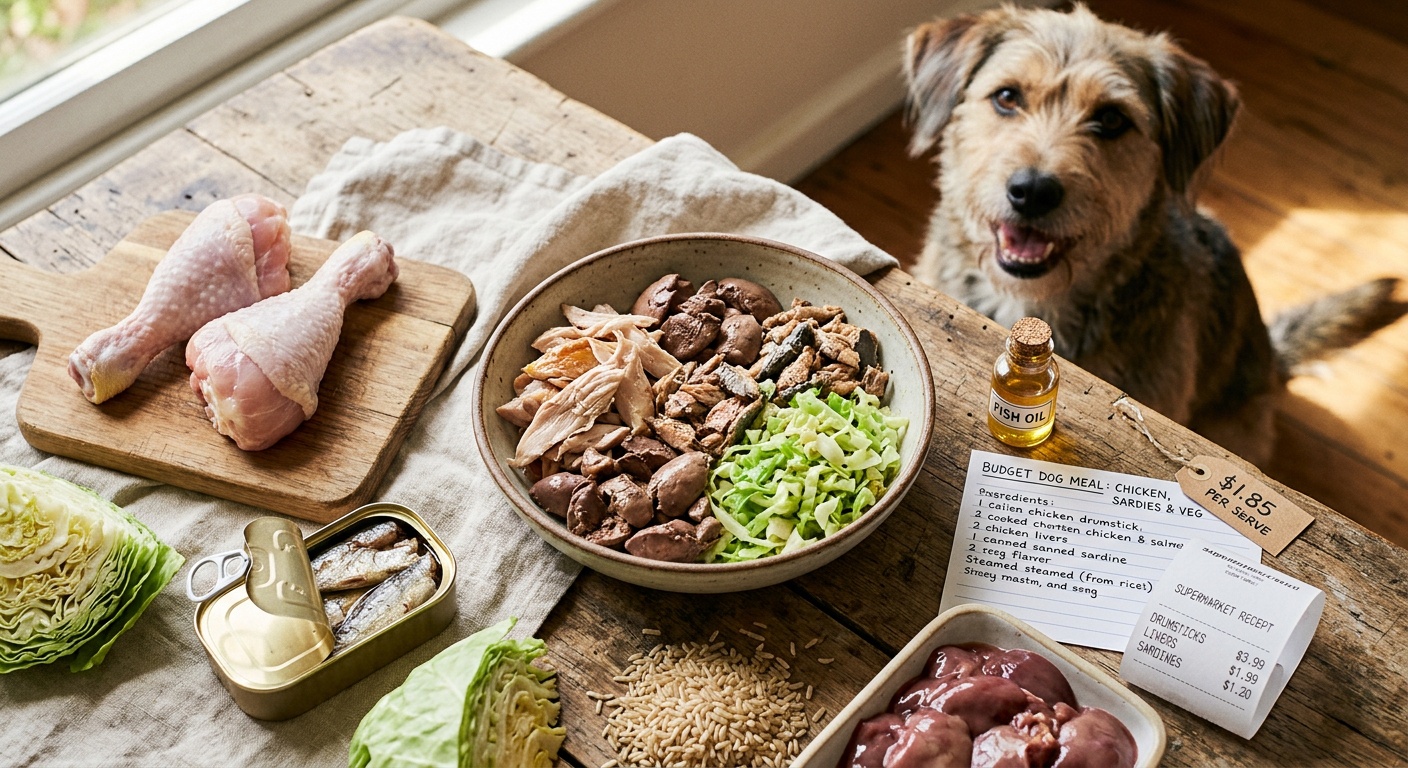
Inflation is real. Budgets are tight. But your dog still deserves real food. This recipe uses the cheapest cuts at the supermarket — drumsticks, chicken livers, sardines, cabbage — and turns them into a genuinely nutritious, complete meal your dog will go crazy for. Under $2 a serve. Batch-cook on Sunday, done for the week.
Place drumsticks in a large pot with 4 cups of water. Bring to a boil, then reduce to a steady simmer for 25 minutes until cooked through. Remove the chicken and let it cool. Do not throw away the water — that's your free chicken broth for the rice. Once the chicken is cool enough to handle, remove and discard all bones. Even small splinter bones are dangerous for dogs. Shred the meat into bite-sized pieces.
Add 1 cup of dry brown rice directly to the chicken broth still in the pot. Bring to a simmer, cover, and cook for 25 minutes until the rice absorbs all the liquid. This makes the rice taste incredible to your dog and wastes zero nutrition from the boiling water.
Heat a dry non-stick pan over medium heat. Add the chicken livers whole and cook for about 3 minutes each side until just cooked through — you want them slightly pink in the middle, not grey and tough. Remove, let cool, then dice into small cubes roughly the size of a blueberry. Over-cooking destroys the B vitamins, so don't go past 6 minutes total.
In the same liver pan, crack in both eggs and scramble gently over low heat. When almost set, throw in the shredded cabbage and diced carrot. Stir-fry for 3–4 minutes until the vegetables are just soft — you want some texture remaining, not mush. Remove from heat.
In a large bowl, mix together the shredded chicken, cooked brown rice, diced livers, and the egg-veg mixture. Drain the sardines and flake them in cold — never heat canned fish as it destroys the omega-3 EPA and DHA. Stir everything together gently. Let the whole bowl cool completely before serving or portioning into containers.
Divide into 5 roughly equal portions. Refrigerate up to 4 days in airtight containers, or freeze up to 3 months. Thaw overnight in the fridge — never microwave dog food as it creates hot spots. Serve at room temperature or slightly warmed.
Chicken drumstick gives complete protein + joint collagen. Liver gives B12, copper and zinc. Sardines give EPA/DHA omega-3. Eggs give biotin and selenium. Cabbage gives gut fibre and vitamin C. Together they hit nearly every nutritional base without expensive supplements.
| Toy (2–5kg) | ¼ serve |
| Small (5–10kg) | ½ serve |
| Medium (10–20kg) | 1 serve |
| Large (20–35kg) | 1.5–2 serves |
| Giant (35kg+) | 2.5–3 serves |
Use our calculator for your exact dog's weight.
Small changes to how and when you shop can cut this recipe cost by another 30–40%.
Chicken livers at butchers or Asian supermarkets often cost half the price of supermarket packs. Buy 500g–1kg at once, portion into 100g bags, and freeze. Same for drumsticks — the 2kg family packs are significantly cheaper per kilo than smaller packs.
Store brand sardines in springwater are nutritionally identical to the premium branded ones. Sardines are always caught wild — there is no factory-farmed sardine. Buy 10 cans at once when on special and you cut the cost even further.
Cabbage is the cheapest vegetable almost year-round. But swap freely with whatever's on special — zucchini, broccoli stalks, sweet potato skins, frozen peas. Dog nutrition is about the week, not the meal. Vary the veg to rotate micronutrients.
Double or triple this recipe on Sunday and freeze in weekly portions. One 90-minute cook feeds your dog for 2–3 weeks. Frozen dog food keeps for 3 months with zero nutritional loss — unlike kibble which loses vitamins once opened.
A 12-pack of eggs costs around $4–5. Each egg adds 6g of complete protein with all 10 essential amino acids, plus biotin, selenium and choline. On a week when the budget is really tight, eggs-and-rice-and-carrot is still a better meal than most kibble brands.
Ask your butcher for chicken frames (carcasses) — $1–2 each. Boil for 2 hours to make a rich bone broth, then pick all the meat off the bones. You get free broth for cooking rice AND extra meat from the carcass. Every cent of value extracted.
This recipe is designed to be flexible. Here's what you can swap with no nutritional compromise — or even an upgrade.
| Original Ingredient | Budget Swap | Why It Works |
|---|---|---|
| Chicken drumsticks | Chicken frames / carcass (~$1–2 each) | More collagen from the cartilage. Boil 2 hrs, pick meat off. |
| Brown rice | Rolled oats | Cheaper, slightly lower GI, great for digestion. Cook same way. |
| Chicken livers | Beef liver (often cheaper per gram) | Higher in zinc and copper. Use same quantity. |
| Sardines | Mackerel in water (usually cheaper) | Even higher omega-3 than sardines. Same drain-and-flake method. |
| Cabbage | Broccoli stalks (free if you eat the heads) | More fibre and vitamin C than the florets. Dogs don't care about presentation. |
| Carrots | Sweet potato skins or pumpkin | Similar beta-carotene profile. Use whatever's cheapest that week. |
| Eggs (2) | Extra egg (add a 3rd) | If the protein cuts are short, eggs are the cheapest way to top up. |
The short answer: at the budget end of the market, no — not when you count what's actually in it.
A mid-shelf kibble for a 15kg dog typically works out to more per day than this recipe — and a cheap homebrand kibble might match the price, but the ingredient list typically reads: cereal by-products, meat meal, soybean meal, salt, artificial preservatives.
This recipe costs the same or less, and the ingredient list reads: boiled chicken, brown rice, chicken liver, sardines, cabbage, carrot, egg. Every single ingredient is something you'd recognise at a glance.
The real saving is long-term. Dogs fed on real whole food consistently show better coat quality, better digestion, fewer vet visits for skin and gut issues, and maintain healthy weight more easily. The upfront cost of real food often saves money on the other end. That's not a marketing claim — it's basic nutrition logic.
This recipe is already strong on protein, omega-3, and organ nutrition. Three inexpensive additions make it fully complete per NRC (National Research Council) 2006 guidelines.
Chicken meat is high in phosphorus and low in calcium. Save your eggshells, dry them in the oven at 100°C for 10 minutes, then grind to powder in a blender. Add ¼ tsp per serving. This is genuinely free and corrects the Ca:P ratio to the NRC target of ~1.2:1.
Good news — the one can of sardines in this recipe already provides adequate EPA and DHA for a medium dog. No need to buy expensive fish oil capsules. Just make sure you use sardines in water, not oil (the oil type adds unnecessary extra fat).
The 100g of chicken liver in this recipe covers copper, zinc, selenium, vitamin D and B12 for the week's batch. You are already doing this right. Just don't increase it — too much liver over 10% of total food intake risks vitamin A toxicity.
If you want a complete safety net without spending much: a generic pet multivitamin powder (around $10–15 for a 3-month supply) covers remaining gaps like manganese, iodine, and vitamin E. Not essential if you're varying ingredients week to week, but good peace of mind.
More homemade meals from basic ingredients
Our free generator adjusts portions and ingredients based on your dog's specific size, breed and health needs
Create Your Custom Recipe →