100×Higher AGEs in dry kibble vs. raw food for the same ingredients
150°CTemperature at which Maillard reaction accelerates significantly
RAGEThe receptor that AGEs bind to — activating NF-κB inflammatory cascade
What Are Advanced Glycation End-Products?
When sugars and proteins (or fats) are exposed to heat, they react with each other in a process called the Maillard reaction. You see the result every time you brown meat in a pan: that golden colour and rich flavour is Maillard chemistry happening. The same process occurs when kibble is extruded at 150–200°C, when treats are baked, and when canned food is sterilised at high temperatures.
Advanced Glycation End-products (AGEs) are the compounds produced by this reaction. They're stable, they don't break down easily during digestion, and a meaningful proportion of them are absorbed into the bloodstream. Once inside the body, they accumulate in tissue over time. They have a particular affinity for collagen-rich tissues — joint cartilage, blood vessel walls, the lens of the eye.
🔬 How AGEs cause damage: the RAGE receptor
AGEs don't just sit inertly in tissue. They bind to a class of receptors called RAGE (Receptor for Advanced Glycation End-products), which are found on immune cells, blood vessel cells, and neurons. When RAGE is activated by AGEs, it triggers the NF-κB inflammatory signalling pathway — the same pathway that produces the chronic low-grade inflammation associated with aging, diabetes, kidney disease, and cardiovascular disease. AGEs also cause direct structural damage by forming cross-links between proteins, making tissue stiffer and less functional over time. This is one mechanism behind joint stiffness in older dogs.
In human medicine, AGE accumulation is well-established as a contributor to diabetic complications, kidney disease, cardiovascular disease, and neurodegenerative conditions. The research in dogs specifically is more limited, but the biochemistry is not species-specific — dogs have RAGE receptors, dogs absorb dietary AGEs, and dogs accumulate AGEs in tissue with age. Several veterinary researchers have begun calling this out explicitly.
How Cooking Method Affects AGE Content
This is the crucial point that most homemade dog food discussions miss entirely. The AGE content of a meal isn't primarily determined by what you feed — it's determined by how you cook it. The same piece of chicken breast can have dramatically different AGE levels depending on the cooking method.
| Cooking Method |
Temperature Range |
Relative AGE Level |
Notes |
| Raw / uncooked |
— |
Very low |
No Maillard reaction. Baseline AGE content only. |
| Poaching / boiling |
~100°C |
Low |
Water limits temperature. Maillard barely activates. Best cooked option. |
| Slow cooker (low) |
~80–90°C |
Low |
Low and slow in liquid. Retains moisture, minimal browning. |
| Steaming |
~100°C |
Low |
Similar to boiling. Good for vegetables. |
| Sautéing / pan fry (brief) |
~150–180°C |
Moderate |
Some browning. AGE generation depends on time and fat used. |
| Baking / roasting |
~180–220°C |
High |
Dry heat + time = significant Maillard product formation. |
| Grilling / broiling |
~200–250°C |
High |
High dry heat. Charred areas particularly dense in AGEs. |
| Kibble extrusion |
~150–200°C |
Extremely high |
High heat + pressure + minimal moisture. Studies show 100× higher AGEs than raw. |
The numbers here are striking. A 2010 study in Veterinary and Comparative Oncology found that dry dog food contains dramatically higher levels of AGEs than home-cooked or raw food with identical ingredients. The Maillard reaction during extrusion, combined with the high starch content of most kibbles (which provides sugar molecules for glycation), creates an AGE density that bears almost no resemblance to what a dog eating fresh food would be exposed to.
Wait — Don't Dogs Actually Love Browned Food?
Yes. And this is where we need to be upfront rather than pretend there's no tension.
The Maillard reaction produces two different categories of compounds simultaneously. One is AGEs — the compounds this article is about. The other is a completely separate group of flavour and aroma molecules: pyrazines, furans, melanoidins, and related compounds that are responsible for the rich smell of roasted meat and the deep flavour of browned protein. These are the compounds that make dogs go absolutely wild for roasted chicken skin or browned beef mince.
We've previously written about how those flavour compounds are part of why dogs find cooked food so palatable — and that's accurate. The palatability benefit and the AGE concern come from the same chemical process. They're real and they coexist.
The honest trade-off
Occasional browning — a quick sear on meat, roasted vegetables as a topper a few times a week — is not going to meaningfully harm a healthy dog. The concern isn't a single browned meal. It's about what your dog eats day after day, year after year. Kibble's AGE problem is so significant partly because it's the only thing many dogs eat, at every meal, for their entire lives. That cumulative load is very different from home cooking that uses browned meat occasionally alongside mostly moist-heat meals. If you occasionally brown your dog's protein for palatability, you haven't failed at low-AGE cooking. The goal is a consistent habit, not a strict rule at every single meal.
The Kibble vs. Fresh Food vs. Raw Question
The AGE data is one of the cleaner arguments for fresh or raw feeding over kibble — not because kibble ingredients are inherently worse, but because the processing method is inherently hotter and more AGE-generating than any home cooking method you'd use.
⚠️ High-AGE (best minimised as daily habit)
- Dry kibble as the sole diet (extruded at 150–200°C)
- Baked commercial treats as the main snack
- Grilled or heavily charred proteins every meal
- Dehydrated treats as the only snack
✅ Lower-AGE (make this the default)
- Poached or boiled proteins in broth
- Slow-cooked meals (slow cooker)
- Steamed vegetables
- Raw food (biologically lowest)
- Occasional browning for palatability — fine in context
That said, raw feeding carries its own risks — bacterial contamination is a genuine concern, particularly for households with immunocompromised people, elderly family members, or young children. Lightly cooking food at lower temperatures is a reasonable middle ground that dramatically reduces AGEs compared to kibble while managing pathogen risk better than fully raw.
An honest note on the research
The human AGE literature is extensive and well-established. The direct causal chain between dietary AGE intake and disease outcomes in dogs is less documented — partly because long-term controlled diet studies in dogs are expensive and rare, and partly because AGE research in veterinary medicine is newer. What we can say with confidence is that dogs absorb dietary AGEs, that AGE-RAGE signalling is biologically active in dogs, and that accumulation occurs. Whether reducing dietary AGEs translates to measurable health improvements in dogs over a lifespan is a study that hasn't been done. This is promising evidence, not a proven cure.
Acidic Marinades and Moist Heat: Two Practical Strategies
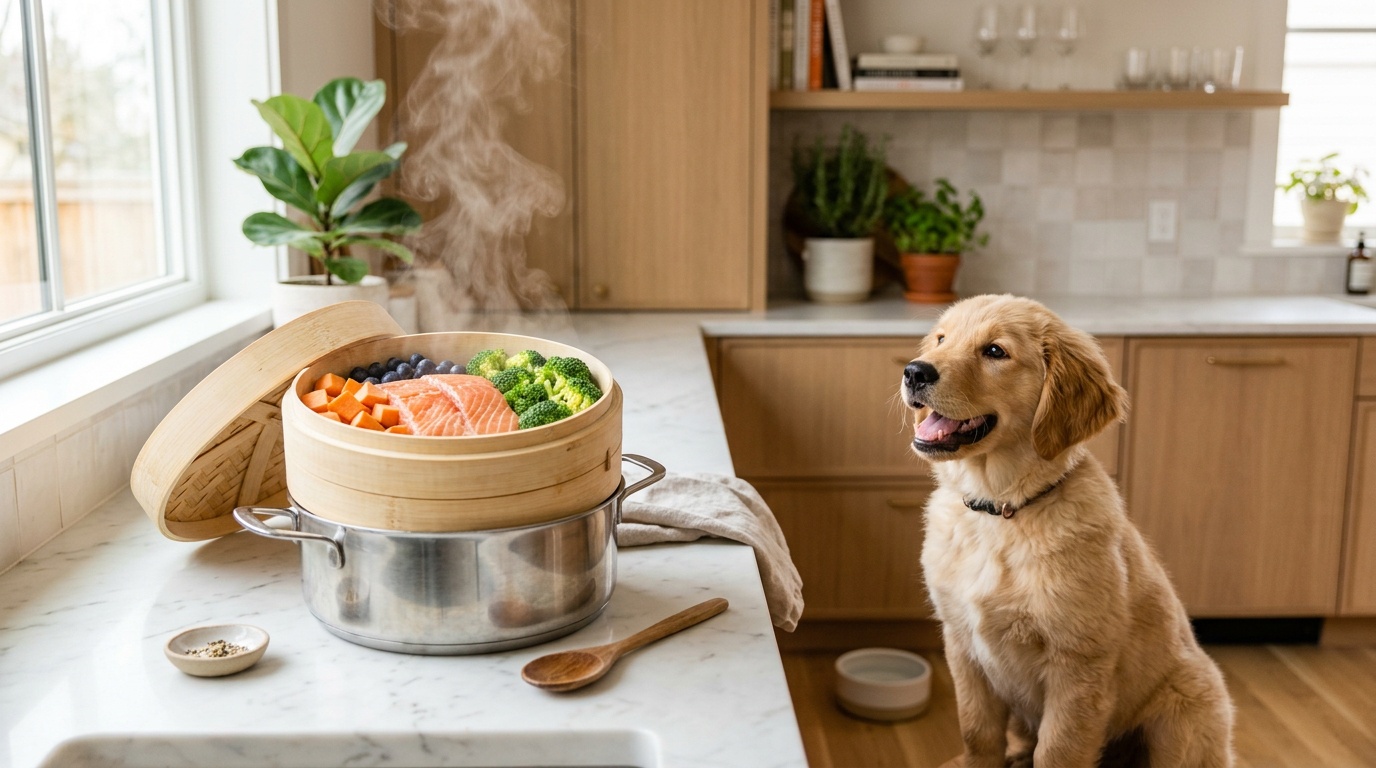
Two cooking strategies from the human AGE research translate well to dog food preparation. The first is moisture. When food is cooked in water or broth, the temperature is capped at or near 100°C regardless of how high the heat is underneath. Maillard chemistry barely runs at this temperature. Poaching chicken thighs in bone broth, slow-cooking beef with vegetables in water, steaming fish — these are all fundamentally different from roasting or baking the same foods.
The second is acidity. Adding an acidic element to marinade or cooking liquid — apple cider vinegar, lemon juice — has been shown in human food research to reduce AGE formation during cooking. The mechanism isn't fully understood, but it's a free intervention that also has digestive benefits. A splash of apple cider vinegar in the cooking liquid is worth adding habitually.
🥘 The practical rule for lower-AGE home cooking
Make moist, low-heat cooking your default — poach, slow-cook, or steam rather than bake, roast, or grill most of the time. Add a tablespoon of apple cider vinegar to the cooking liquid when you can. If your dog is a fussy eater and browning the protein is what gets them to eat, that's a completely reasonable trade-off — palatability matters too. The goal is lowering the chronic daily AGE load, not eliminating every browning reaction forever. Over a decade of meals, making moist-heat cooking the norm rather than the exception is where the benefit lies.
What About Commercial Wet Food?
Canned and pouch wet foods are sterilised at high temperatures (typically 120°C+ for the Maillard reaction to be significant), so they do generate more AGEs than gently home-cooked meals. However, the temperatures are lower than kibble extrusion, moisture content is much higher, and cooking time is shorter. Studies generally show that canned food sits between raw and kibble on the AGE spectrum — better than dry food, not as low as fresh home cooking.
Lightly cooked commercial options and freeze-dried raw are increasingly available and represent genuinely lower-AGE commercial choices, though the research on these products specifically is still limited.
Connecting This to the Longevity Picture
If you've been reading the Longevity Deep Dive series, you'll recognise where AGEs fit. In Part 4 (Zombie Cells), we discussed the SASP inflammatory phenotype — senescent cells releasing cytokines that damage surrounding tissue. AGEs activate the same NF-κB inflammatory pathway through a completely separate mechanism. In other words, you have at least two significant dietary inputs that are both feeding chronic inflammation: senescent cell accumulation (which you can address with quercetin/fisetin-rich foods) and dietary AGE load (which you address with cooking method).
The low-AGE cooking approach and the senolytic food approach are entirely compatible. A slow-cooked beef and vegetable bowl with apple, broccoli, and blueberries added cold addresses both problems simultaneously. That's the recipe we've put together in the Senolytic Bowl — and it's designed explicitly to be cooked low and slow in broth.
→ Coming up: The Low-AGE Kitchen Guide
A practical cooking guide — recipes, temperature charts, and techniques for keeping AGE content low in every meal you make.