Key takeaways
- The ASPCA lists garden parsley, Petroselinum crispum, as toxic to dogs because it contains photoactive furanocoumarins.
- The reported concern is photosensitisation, and the ASPCA notes that a large amount is needed to cause this effect.
- Flat-leaf Italian parsley and curly parsley are varieties of the same species. Curly parsley is not proven to be free of the compounds that cause concern.
- Breed-to-Bowl recipes will use only curly parsley, in very small optional amounts, as a cautious practical rule. It is not an essential ingredient.
- If a dog eats a large or unknown amount, develops symptoms, or may have eaten a different plant, contact a veterinarian or animal poison service promptly.
A friend recently had the sort of kitchen scare that sends everyone straight to their phones. Tyson had eaten some flat-leaf parsley. Parsley seemed harmless, perhaps even healthy, until a toxic-plant listing said otherwise.
The confusing part is that the warning is real, but it is easy to read it without the dose or botanical context. A stray leaf is not the same exposure as a dog consuming a bunch. Curly parsley is often described online as the safer choice, yet flat and curly parsley are closely related varieties of the same culinary species. The honest answer is more careful than either “parsley is safe” or “one leaf will poison your dog.”
If your dog has just eaten parsley
Remove access to the plant and keep its packet or take a clear photograph. Note which type it was, approximately how much is missing, when it happened, your dog's weight and any symptoms. Call your veterinarian or a recognised animal poison service if the amount was large or uncertain, if the plant identity is uncertain, or if your dog seems unwell. Do not induce vomiting or give a home remedy unless a veterinary professional tells you to.
Why parsley appears on toxic-plant lists
The ASPCA identifies parsley's toxic principle as furanocoumarins. These plant compounds can become photoactive. After sufficient exposure, ultraviolet light can activate them and damage skin, producing a reaction called photosensitisation.
Laboratory analysis of fresh parsley has identified several photoactive furanocoumarins, including oxypeucedanin, psoralen, bergapten and xanthotoxin. That establishes that the compounds are present. It does not give us a simple household dose at which a particular dog will become ill.
The ASPCA's wording matters: large amounts are needed to produce the listed effect. Reliable canine dose-response data for ordinary culinary parsley are limited, so it would be misleading to publish a universal number of leaves or grams as “safe.” Risk depends on the amount, the dog's size, the exact plant and individual health factors.
What photosensitisation looks like
Photosensitisation is not an ordinary sunburn. Photoactive molecules in the skin absorb ultraviolet light and trigger tissue damage. Merck describes discomfort in bright light, rubbing or scratching, redness and swelling, especially on exposed or lightly pigmented areas such as the ears, eyelids and muzzle. More serious cases may develop weeping skin, scabs or tissue damage. These signs need veterinary attention.
Flat leaf and curly are not different species
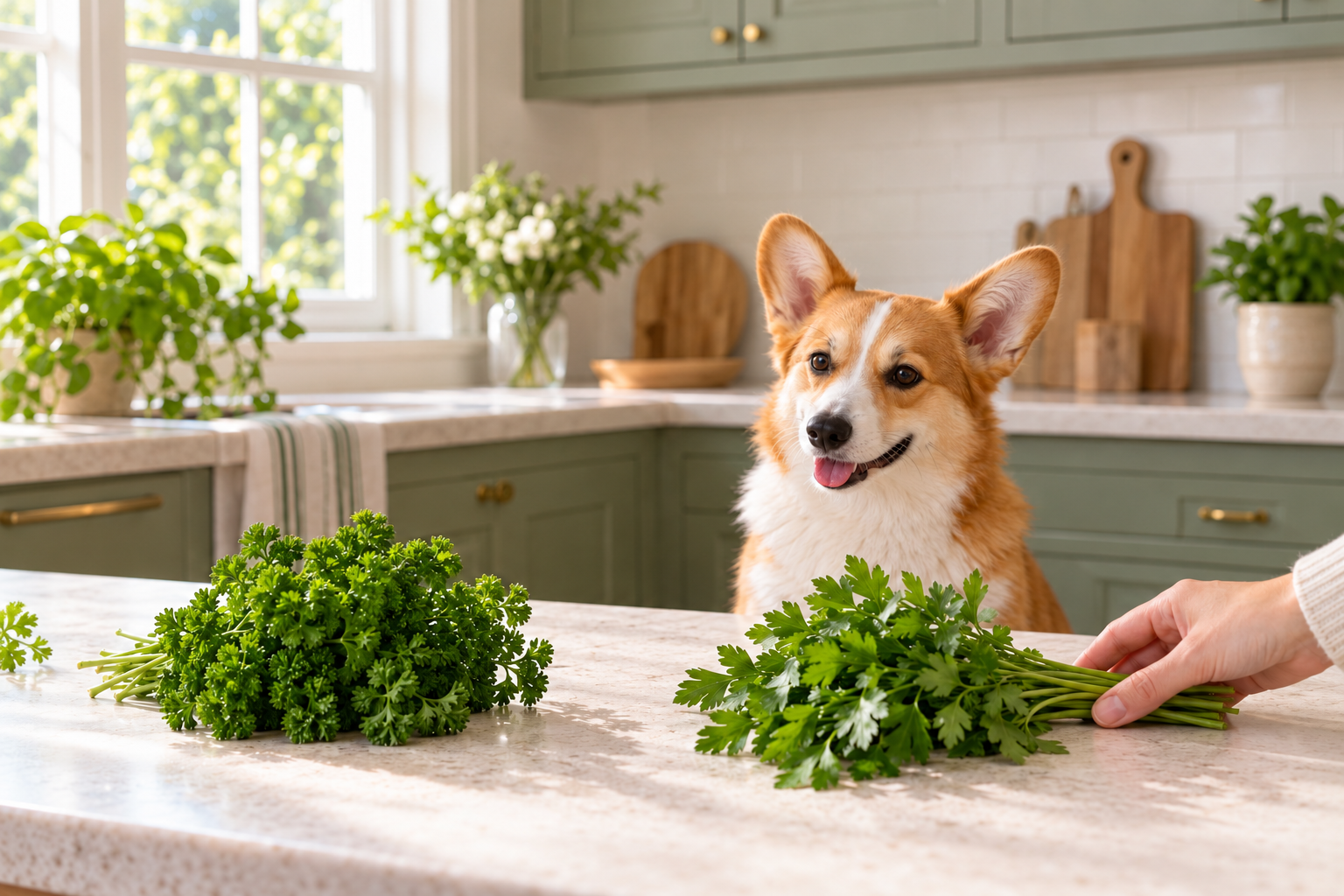
Flat-leaf parsley is commonly called Italian parsley. Curly parsley has compact, ruffled leaves. The plants look different enough that it is tempting to place them into separate safety categories, but both are cultivated forms of Petroselinum crispum.
The University of Wisconsin describes flat or Italian parsley as the variety neapolitanum and curly parsley as the variety crispum. The same source notes that curly types contain less essential oil than broad-leaved types. Essential-oil content, however, is not the same measurement as furanocoumarin safety, and it does not prove that curly parsley contains none.
This is why Breed-to-Bowl will take a deliberately cautious position. We will not use flat-leaf parsley in dog recipes. If parsley appears at all, it will be curly parsley, clearly identified and used only as a tiny optional garnish. Owners can leave it out without affecting the recipe's nutritional balance.
So is curly parsley safe for dogs?
Some veterinary-facing consumer guidance describes curly parsley as the safest culinary variety for dogs when given sparingly. That is useful practical advice, but “safer” should not be rewritten as “toxin-free.” The ASPCA listing covers Petroselinum crispum, the species that includes culinary curly parsley.
There is also little nutritional reason to push the issue. A pinch of parsley will not correct a homemade diet that is short of calcium, iodine, vitamin D, zinc or essential fats. It is a garnish, not a supplement. Claims that it detoxifies the body, treats urinary disease or reliably fixes bad breath are not a sound reason to add it to every bowl.
If your veterinarian is comfortable with it and your dog has no relevant medical restriction, a few finely chopped curls used occasionally are a much more conservative choice than handfuls, juice, concentrated extracts or daily supplementation. When in doubt, simply omit it.
Breed-to-Bowl parsley rule
- Use only correctly identified culinary curly parsley.
- Treat it as an optional garnish, never a therapeutic supplement.
- Use a tiny amount rather than a handful.
- Do not use flat-leaf Italian parsley in the dog's portion.
- Do not use parsley oils, extracts, juices or concentrated products.
- Leave parsley out for dogs with medical conditions unless their veterinarian approves it.
Plant identification matters
Common names cause another problem. “Spring parsley” can refer to Cymopterus watsonii, a different photosensitising plant discussed in veterinary toxicology. “Chinese parsley” usually means coriander or cilantro. Wild plants in the carrot family can resemble edible herbs, and some are far more dangerous.
Do not use a phone identification app as the final word before feeding a garden plant. For a purchased herb, keep the labelled packet. For an unknown plant, prevent access and ask a veterinarian, poison service or qualified botanist to identify it.
What to watch after accidental ingestion
A dog that stole one small culinary leaf and remains completely well is not in the same situation as a small dog that ate most of a bunch. The right response depends on the actual exposure, which is why a poison service asks about weight, amount, timing and symptoms.
Seek prompt veterinary advice if you notice repeated vomiting or diarrhoea, marked lethargy, facial or skin swelling, redness on exposed skin, unusual discomfort in daylight, persistent rubbing of the face or eyes, blistering, weeping skin, or any rapid deterioration. Any dog with breathing difficulty, collapse or severe distress needs emergency care.
Until you receive advice, keep the dog from eating more. If skin sensitivity or light-associated discomfort appears, move the dog out of strong sunlight and contact a veterinarian immediately. Do not wait for photographs from the internet to match what you see.
Do not panic, but do not guess
“Toxic” does not mean that every tiny exposure causes poisoning. It means the plant contains compounds capable of causing harm under the right conditions. The amount Tyson ate, his size and how he feels now matter more than the word on a list. A veterinarian or animal poison specialist can assess those details properly.
The practical answer
Flat-leaf parsley should stay out of the dog's bowl. Curly parsley is the more conservative culinary choice, but it belongs in the optional-garnish category, not the unlimited-safe-food category. There is no need to add it for nutritional completeness.
Most importantly, an accidental small nibble should be assessed in proportion to the exposure, while a large or uncertain amount deserves professional advice. That is more useful than treating every leaf as an emergency or assuming that a familiar kitchen herb cannot cause trouble.
Sources
- ASPCA Animal Poison Control. Parsley: toxic and non-toxic plant profile.
- Merck Veterinary Manual. Photosensitisation in dogs.
- Merck Veterinary Manual. Overview of photosensitisation in animals.
- Chaudhary SK et al. Oxypeucedanin, a major furocoumarin in parsley.
- Royal Botanic Gardens, Kew. Petroselinum crispum taxonomic record.
- University of Wisconsin Extension. Curly and flat-leaf parsley varieties.
Veterinary note: This article provides general information and cannot assess an individual exposure. Contact your veterinarian or an animal poison service for advice about your dog.