Key takeaways
- Cooking does not destroy all nutrients. Its effects depend on temperature, time, water, oxygen, food and nutrient.
- Water-soluble vitamins are generally more vulnerable to leaching and heat than minerals or fat-soluble vitamins.
- Minerals are not destroyed by normal cooking, although they can move into discarded cooking liquid.
- Cooking can improve starch and protein digestibility and reduce microbial hazards.
- A recipe should be formulated using nutrient data that matches the cooked form and method.
“Cooking destroys nutrients” sounds precise, but it bundles many different reactions into one frightening sentence. A carrot steamed for five minutes is not nutritionally identical to one boiled for an hour and drained. Chicken baked until safely cooked is not equivalent to meat repeatedly reheated until dry. The useful questions are which nutrient, which food, which method and where the cooking liquid went.
Protein changes, but change is not destruction
Heat unfolds proteins, a process called denaturation. Digestive enzymes can often access these unfolded structures more easily. Adequate cooking also softens connective tissue and gelatinises starch, improving the digestibility of many ingredients. This is one reason cooked rice and potato are very different from their raw forms.
Very severe heating can reduce the availability of some amino acids. The Maillard reaction that creates browning can bind reactive amino acids such as lysine, especially when heat, time and low moisture combine. Normal home cooking is not automatically a problem, but scorching and repeated high-temperature treatment are not nutritional virtues.
Vitamins are where method matters most
Vitamin C and several B vitamins are water-soluble. They may degrade with heat or leach into water. Thiamine is notably heat-sensitive. Retention depends on the size of the pieces, cooking duration, water volume and whether liquid is eaten. If chicken and vegetables simmer in plain water that becomes part of the meal, leached nutrients have not all left the bowl. If the water goes down the sink, some do.
Fat-soluble vitamins A, D, E and K do not leach into water in the same way, but heat, light and oxygen can still affect them. Some plant compounds become more available after cell walls soften; others decrease. There is no universal percentage that can be applied to every ingredient.
Retention is not the same as concentration
Cooking changes water content. A baked ingredient may show more nutrient per 100 grams simply because it lost water, while a boiled ingredient may look more dilute. Compare nutrients on a consistent basis and use the weight state named in the recipe.
Minerals do not vanish in the oven
Calcium, phosphorus, zinc, copper and other minerals are elements. Household cooking temperatures do not destroy them. They can, however, migrate into cooking water or drippings. Removing skin, bone or liquid also removes whatever nutrients those parts contain.
This matters for homemade dog food because a recipe's calcium-to-phosphorus balance cannot be guessed from a raw ingredient list. Boneless meat remains phosphorus-rich and calcium-poor after cooking. Adding vegetables does not usually close that gap. Read the calcium mistake most homemade recipes make for the full explanation.
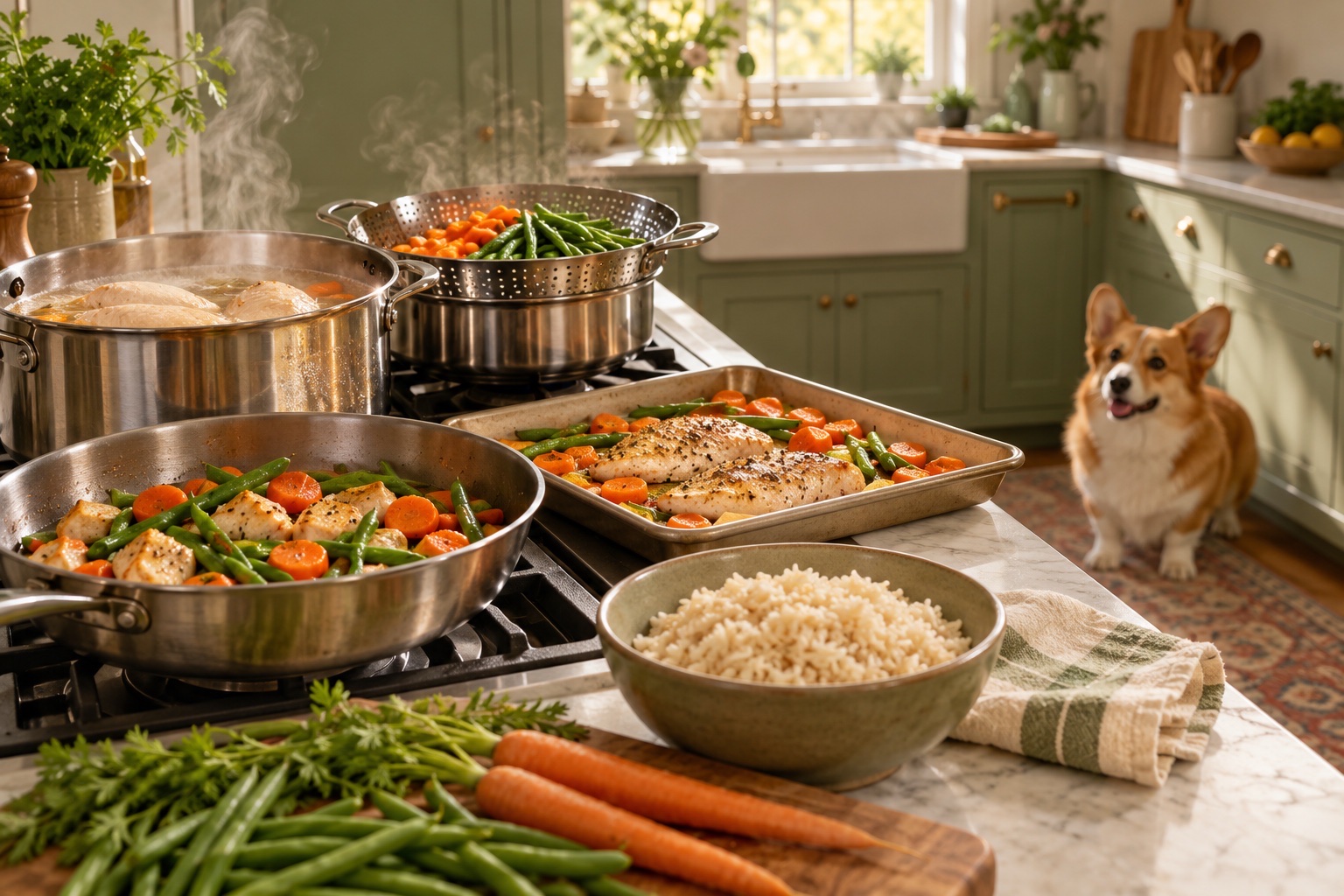
Boiling, steaming, baking and sautéing
Boiling and poaching
Gentle wet heat is useful for lean meats and can be easy to digest. The main nutritional issue is leaching. Use minimal unsalted water and retain an appropriate amount in the recipe when the formulation allows. Never use onion, garlic or salty stock for a dog's portion.
Steaming
Steaming limits direct contact with water and often retains water-soluble vitamins better than boiling. It works well for many vegetables. It does not make an incomplete recipe complete, and safe internal temperatures still matter.
Baking and roasting
Dry heat avoids water losses but can cause greater surface browning and moisture loss. Bake until safely cooked, not until hard. Weigh ingredients in the state specified by the formula, since 200 grams raw chicken will not remain 200 grams after roasting.
Sautéing
Short cooking can preserve texture and some vitamins, but added fat changes calories quickly. Cook the dog's food before garlic, onion, sauces or seasoning enter the pan. Avoid heavily charred surfaces.
Pressure and slow cooking
Pressure cooking uses higher temperature for less time; slow cooking uses lower temperature for much longer. Nutrient retention depends on the specific combination and whether liquid is retained. Neither method can be declared universally superior.
Food safety is a nutritional advantage too
Cooking reduces viable bacteria and parasites when correct temperatures and handling are used. The US Centers for Disease Control and Prevention does not recommend raw pet food because raw animal products can carry pathogens that affect pets and people. Puppies, older adults, pregnant people and immunocompromised household members deserve particular care.
Cook poultry to a safe internal temperature, prevent raw juices from contaminating counters, cool batches promptly and refrigerate or freeze in shallow portions. Reheating should make food pleasantly warm, never hot enough to burn.
Why published retention factors matter
The USDA nutrient-retention tables provide factors for estimating nutrients retained after cooking. They are averages, not measurements of your particular saucepan, but they are better than assuming 100 percent retention. A serious formulation starts with analysed or reputable food-composition data, chooses the closest cooked item, applies appropriate yield and retention factors, and then checks the complete recipe against NRC or AAFCO targets.
Supplements can be affected by heat too. Some veterinary-formulated home-cooking supplements are added after the batch cools; others have specific instructions. Follow the product or formulator exactly. Moving a supplement from “after cooking” to the boiling pot is a recipe change.
A sensible home-kitchen method
- Choose gentle cooking sufficient for safety.
- Use as little unsalted water as practical and retain liquid only when the recipe includes it.
- Weigh foods in the raw or cooked state specified.
- Cool before adding heat-sensitive oil or supplements when directed.
- Portion, chill and freeze promptly.
Cooking cannot repair formulation
A carefully steamed bowl of chicken, rice and carrots can still be low in calcium, iodine, vitamin D, vitamin E, copper, zinc and essential fatty acids. Technique preserves the nutrients present. It does not create the ones missing.
The practical answer
Cooking trades some losses for gains in digestibility, palatability and safety. The goal is not to preserve every molecule at all costs. It is to deliver a safe, complete diet whose nutrient content after preparation meets the dog's needs.
For Basil's food, that means repeatable weights, modest heat, the correct cooking liquid, and supplements added exactly where the recipe says. It is less dramatic than “raw versus cooked,” but far more useful.
Sources
- USDA. Table of Nutrient Retention Factors, Release 6.
- Lee S et al. Effects of different cooking methods on nutritional qualities of vegetables.
- Review of cooking and nutrient retention.
- CDC. Pet food safety.
- WSAVA Global Nutrition Committee. Nutrition assessment guidelines.
Veterinary note: Ask your veterinarian or a qualified veterinary nutrition professional before relying on a home-cooked recipe as the main diet.