Key takeaways
- Boneless meat contains substantial phosphorus and little calcium, so meat-heavy homemade diets often have a very low calcium-to-phosphorus ratio.
- Published analyses place chicken eggshell at roughly 360 to 400 mg calcium per gram, but shell composition and household spoon weights vary.
- “Add one teaspoon” is poor advice unless the recipe, powder concentration and target are all defined.
- Balancing calcium does not supply vitamin D, vitamin E, iodine, zinc, copper, manganese or essential fatty acids.
- Puppies and dogs with kidney, parathyroid, urinary or other medical conditions should not receive improvised calcium supplementation.
Why meat-heavy bowls run short of calcium
Muscle contracts using calcium, but muscle meat is not a calcium-rich food. It is, however, a meaningful source of phosphorus. Remove the skeleton from an animal and the mineral relationship changes dramatically: the meat remains, while the major calcium reservoir does not.
That is why boneless chicken, beef or turkey served with rice and vegetables can look substantial while supplying far more phosphorus than calcium. The body regulates blood calcium tightly. A low-calcium, high-phosphorus diet fed over time can stimulate hormonal responses that draw minerals from bone. MSD Veterinary Manual describes nutritional secondary hyperparathyroidism among the consequences of inadequate calcium or excessive phosphorus.
What eggshell powder actually contains
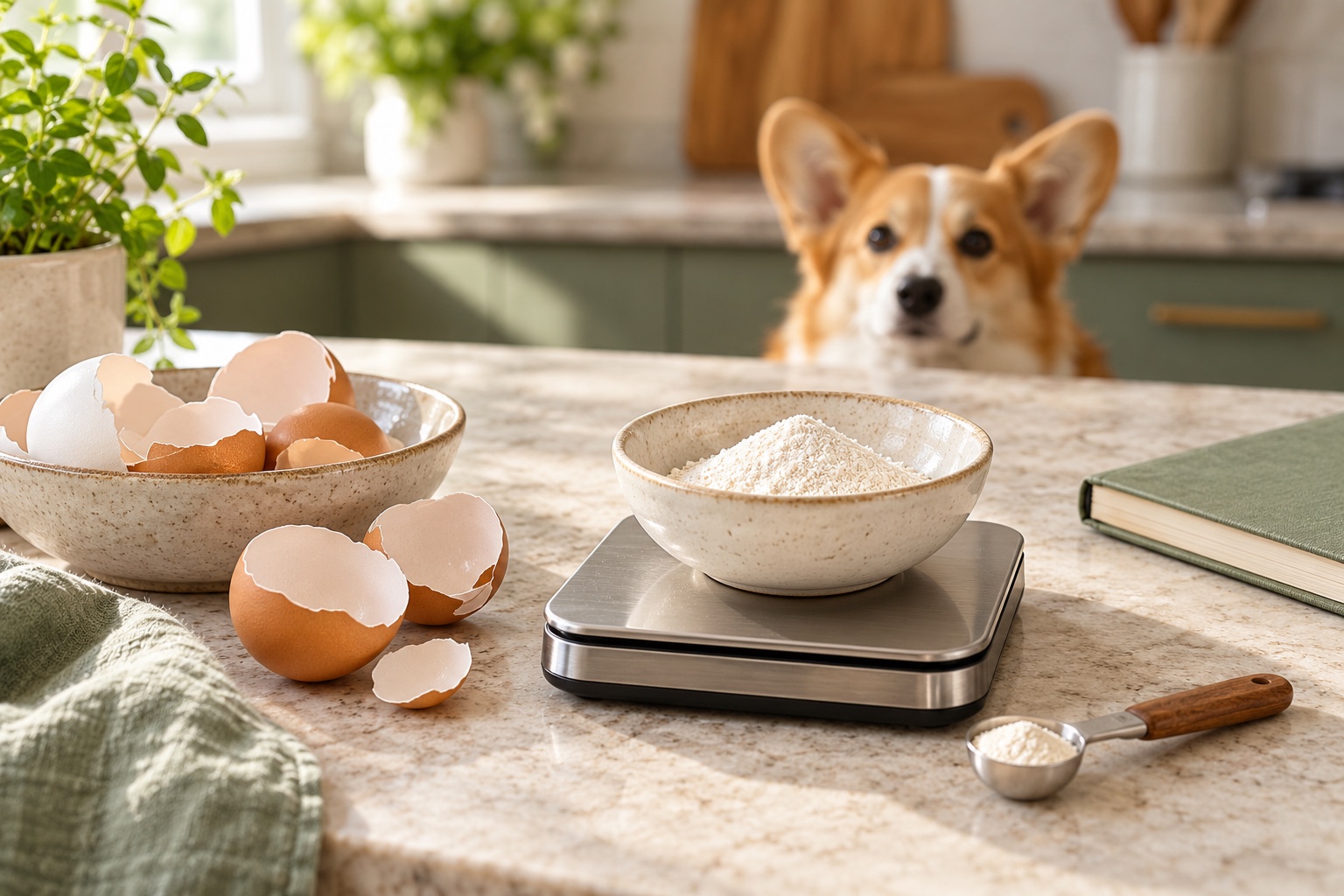
Eggshell is predominantly calcium carbonate. A peer-reviewed review of heat-treated chicken eggshell reported an average of about 378 mg calcium per gram, with published values generally around 360 to 400 mg per gram. That makes it concentrated, which is useful when the amount is calculated and risky when it is guessed.
Eggshell contributes calcium, but almost no phosphorus and no complete vitamin-and-trace-mineral package. It can correct one part of a formula. It cannot turn an arbitrary meat-and-vegetable bowl into a complete diet.
The calculation is recipe-specific
A formulator first totals the calcium and phosphorus already present in every ingredient, then chooses an appropriate target within the full nutritional standard.
additional calcium needed = (target Ca:P × total phosphorus) − calcium already in the recipepowder needed = additional elemental calcium ÷ verified calcium per gram of powderThis shows why body weight alone cannot tell you how much eggshell belongs in a batch. The food's phosphorus load, existing calcium, energy density, portioning and life stage all matter.
Why “a teaspoon per pound of meat” can fail
- Meats differ: chicken breast, minced beef, liver, fish and bone-in ingredients do not carry the same mineral profile.
- The rest of the bowl counts: rice, oats, eggs, dairy, sardines with bones and commercial supplements change the calculation.
- Powders differ: commercial labels may state elemental calcium per gram or per spoon; homemade powder varies with grinding and packing.
- Calories matter: nutritional standards are commonly expressed relative to energy or dry matter, not simply per kilogram of dog.
- Life stage matters: growing dogs have narrower tolerances and different targets from healthy adults.
How to prepare eggshell powder safely
- Use clean shells from fully cooked eggs. Discard dirty, mouldy or cracked shells that have sat at room temperature.
- Boil the shells for 10 minutes. Research on household eggshell use identifies Salmonella as the main concern and supports thorough heat treatment.
- Dry them completely. Place on a clean tray in a low oven until brittle and moisture-free. Avoid browning.
- Grind to a very fine powder. Gritty fragments are difficult to distribute evenly. Use a clean spice grinder and let dust settle before opening it.
- Weigh the powder. A scale reading to 0.1 g is more dependable than a teaspoon. For a commercial product, use its verified elemental-calcium declaration.
- Mix through the entire cooled batch. Distribution matters. Do not sprinkle an estimated pinch over one serving.
Preparation safety is not formulation safety
Boiling and drying can reduce microbial risk. They do not tell you the correct dose. A beautifully prepared jar of powder can still be used incorrectly.
Balancing a recipe is not random supplementation
In a formulated recipe, every ingredient has a defined cooked weight. Nutrient totals are compared with an appropriate standard, and the supplement plan is chosen to close the identified gaps without creating excesses. Changing the meat, leaving out an ingredient, doubling vegetables or swapping supplements can undo that work.
Random supplementation works backwards: it begins with a product or rule of thumb and assumes the diet needs that amount. It may under-correct calcium, overshoot it or duplicate calcium already supplied by bone, sardines, dairy or a canine completer.
Our chicken and rice analysis shows why calcium is only one of several gaps that need attention.
Puppies are not small adult dogs
Growth depends on tightly controlled mineral intake as well as total energy. Excess calcium is especially concerning in growing large and giant breeds, while inadequate calcium is also unsafe. MSD Veterinary Manual notes that growing dogs are more vulnerable to problems from excessive calcium. Do not adapt an adult recipe for a puppy by scaling the portion or adding extra shell.
When not to formulate this yourself
- puppies, pregnant or nursing dogs
- dogs with kidney disease, urinary stones, parathyroid disease or abnormal blood calcium
- dogs taking vitamin D, calcium, phosphate binders or complex supplements
- recipes containing edible bone or a commercial home-cooking completer
- any diet intended as the sole long-term food
For these situations, ask your veterinarian for referral to a board-certified veterinary nutritionist or another appropriately qualified veterinary nutrition professional. Take the exact recipe, product labels, laboratory results and your dog's medical history.
Sources
- Bartter J et al. Use of chicken eggshell to improve dietary calcium intake.
- Waheed M et al. Review on the extraction of calcium supplements from eggshells.
- MSD Veterinary Manual. Nutritional requirements of small animals.
- FDA. “Complete and balanced” pet food.
- AAFCO. Dog Food Nutrient Profiles.
- UC Davis Center for Companion Animal Health. Study sheds light on home-cooked diets for dogs.
Veterinary note: This article explains principles; it does not prescribe a dose for an individual dog or an unanalysed recipe. Check with your veterinarian before changing the diet or adding calcium.