Key takeaways
- Chicken and rice provides energy and protein, but it is not complete and balanced for long-term feeding.
- The largest visible problem is calcium: boneless chicken contributes far more phosphorus than calcium.
- Adding carrots, peas or broccoli improves variety, but does not reliably correct calcium, essential fats, vitamin D, vitamin E, iodine, zinc, copper and other gaps.
- A properly formulated homemade diet is built to a nutritional standard for the dog's life stage. It is not a basic bowl with a supplement guessed on top.
- For a stomach upset, ask your veterinarian whether a therapeutic gastrointestinal diet or a very short-term bland meal is appropriate.
Chicken and rice has earned a place in dog-owning folklore because it is plain, familiar and easy to cook. That does not make it nutritionally complete. VCA notes that cooked chicken breast with white rice is deficient in more than ten essential nutrients. Its legitimate role is narrow: a temporary, highly digestible meal when a veterinarian recommends it, not a default diet for weeks or months.
What the bowl provides
- Protein and amino acids: chicken is a concentrated animal protein.
- Energy: white rice supplies digestible carbohydrate; the precise calorie density changes with the chicken cut and the chicken-to-rice ratio.
- Some B vitamins, selenium and phosphorus: chicken contributes these, but having several nutrients does not prove the complete profile is adequate.
- Low fibre and a relatively simple ingredient list: useful in some short-term feeding plans, but not an advantage for every dog or every condition.
What may be missing or inadequate
Calcium is the obvious structural gap
Muscle meat is rich in phosphorus and naturally low in calcium. Rice adds more phosphorus without supplying enough calcium to correct the relationship. AAFCO's published adult-maintenance profile places the calcium-to-phosphorus ratio between 1:1 and 2:1. A plain chicken-and-rice bowl commonly sits far below that range.
That does not mean every bowl should receive a teaspoon of eggshell. The required calcium depends on the recipe's actual phosphorus and calcium, its calorie content, the dog's life stage and any other mineral source. Read our eggshell calcium calculation guide before treating a spoon measure as a formula.
Essential fats are more than “some fat”
Chicken contains fat, but a complete diet must supply essential fatty acids in suitable amounts and relationships. Skinless breast, thigh, added olive oil and fish oil are not nutritionally interchangeable. EPA and DHA may be useful additions in a formulated diet, but adding fish oil also changes vitamin E considerations and should not be improvised.
Vitamins and trace minerals are easy to overlook
Vitamin D, vitamin E, iodine, zinc, copper, manganese and choline are among the nutrients that can be inadequate in home recipes. UC Davis researchers assessed 200 published dog-food recipes and found 95% lacked at least one essential nutrient; more than 83% had multiple deficiencies. Rotating several similarly incomplete bowls did not reliably solve the problem.
Why vegetables do not finish the formula
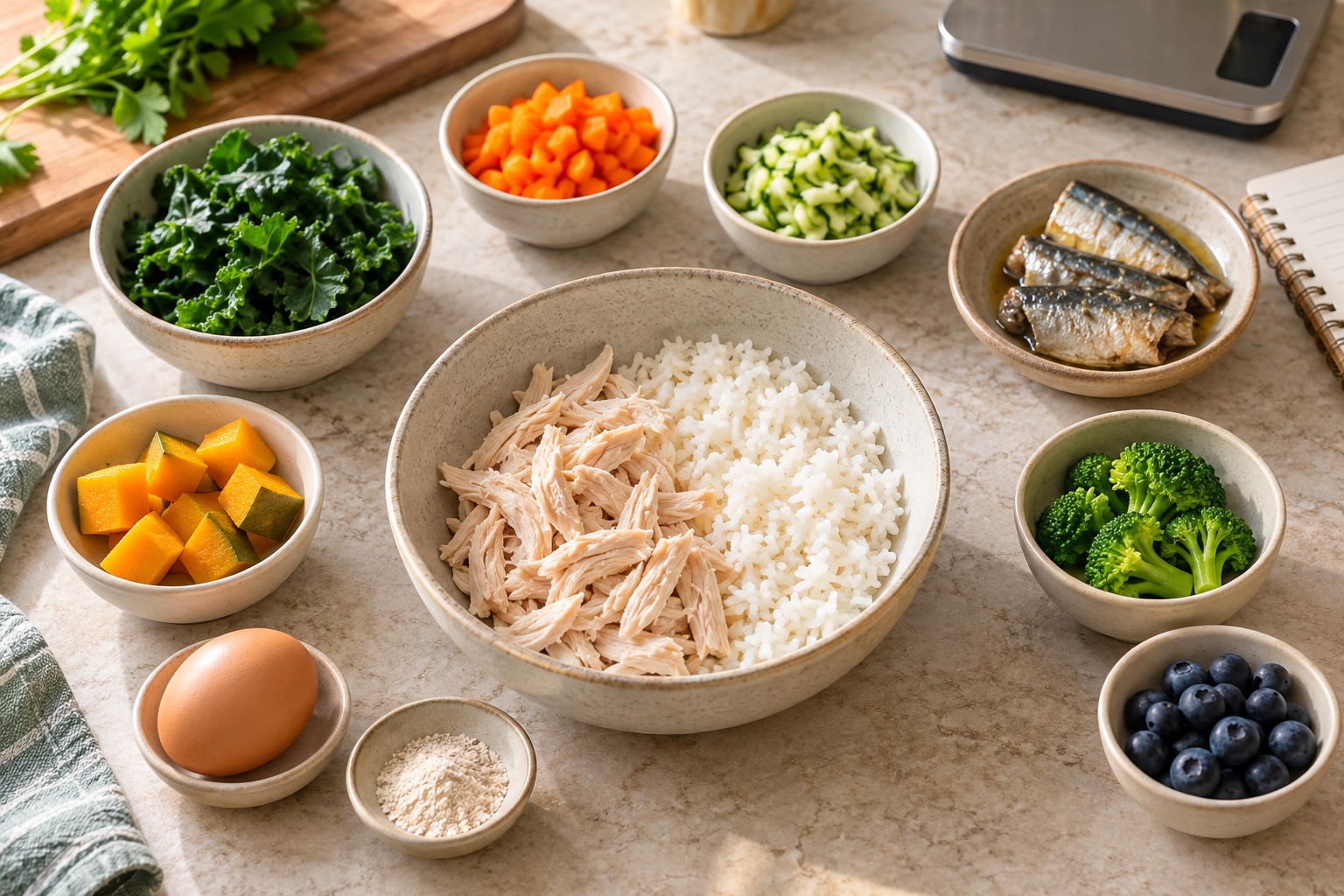
Carrots, green beans, pumpkin and leafy vegetables can contribute fibre, carotenoids and variety. They do not automatically supply enough calcium, vitamin D, iodine, zinc, copper or essential fatty acids. A colourful bowl can still be nutritionally incomplete.
The useful question is not “Does this look healthy?” It is “Does the complete recipe deliver every required nutrient in relation to its energy, in the correct amounts and ratios for this dog?”
Three bowls that look similar but are not equivalent
Protein and digestible carbohydrate. Appropriate only as a short-term bland meal when a vet agrees. Not complete for regular feeding.
More fibre and variety, but the central calcium and micronutrient problems remain. “More ingredients” is not the same as formulated.
Exact cooked weights, calories and a complete nutrient calculation against an appropriate standard, plus the specific supplements that calculation requires.
So when is chicken and rice reasonable?
A veterinarian may recommend a brief bland diet after vomiting has stopped or for uncomplicated diarrhoea in an otherwise bright adult dog. It is not appropriate for every gastrointestinal problem. Puppies, older dogs, very small dogs and dogs with repeated vomiting, blood, pain, marked lethargy or medical conditions need individual advice.
Our gentle chicken and rice recovery meal is deliberately labelled as a short-term bridge. For everyday cooking, start with the calorie calculator and use a recipe formulated for the dog's life stage rather than extending a recovery bowl indefinitely.
Sources
- VCA Animal Hospitals. Bland diet instructions for dogs and cats.
- UC Davis Center for Companion Animal Health. Study sheds light on home-cooked diets for dogs.
- FDA. “Complete and balanced” pet food.
- AAFCO. Dog Food Nutrient Profiles.
- UC Davis School of Veterinary Medicine. Nutrition Support Service FAQs.
Veterinary note: Check with your veterinarian before changing your dog's diet. Puppies, pregnant or nursing dogs and dogs with kidney, liver, pancreatic, urinary or gastrointestinal disease require individual nutrition advice.