Key takeaways
- Golden Retrievers are often food-motivated, but appetite varies greatly between individuals.
- The famous POMC deletion linked with hunger and obesity has been demonstrated in Labrador and flat-coated retrievers, not Golden Retrievers.
- Breed, neuter status, age, activity, calorie density, learned behaviour and disease can all influence weight and apparent hunger.
- Feed by calories and body condition rather than the package's cup suggestion alone.
- A sudden increase in appetite, especially with weight loss, thirst or other symptoms, needs veterinary assessment.
Golden Retrievers have perfected the hopeful stare. Their reputation for being hungry is reinforced by the traits that make them excellent working and family dogs: they are attentive, trainable and keen to interact. Food is a powerful reward, and a clever dog quickly learns which look makes toast fall from the sky.
But behaviour is not the same as energy need. A dog may ask because asking has worked, because a routine predicts food, because the meal is eaten quickly, or because something medical has changed. The useful question is not “Is my Golden pretending?” It is “What is driving this dog's appetite, and is their body condition healthy?”
How the appetite system works
Appetite emerges from signals exchanged among the gastrointestinal tract, fat tissue, pancreas and brain. Hormones and nutrients communicate whether energy has arrived and how much reserve is available. The hypothalamus integrates those messages with smell, learned cues, stress and the availability of food. This is why fullness is not a single switch.
Food reward also has a separate dimension. A dog can be nutritionally fed yet remain eager to work for a treat. Retrievers have been selected for cooperation and persistence; those qualities make food reinforcement wonderfully effective. They do not prove a biological defect.
The POMC story, and where Golden Retrievers fit
Research in Labrador Retrievers identified a deletion in the POMC gene associated with higher weight, body condition and food motivation. A related study found the variant was common in assistance-dog Labradors and also present in flat-coated retrievers. More recent work linked the deletion with greater hunger and lower resting metabolic rate in Labradors.
Golden Retrievers belong to the retriever group, but close breed relationships do not make genetic findings interchangeable. The published POMC deletion work did not establish the same variant as an explanation for Golden appetite. It is inaccurate to tell Golden owners that the Labrador “hunger gene” is why their dog begs.
What we can say confidently
Some retriever breeds have documented appetite-related genetic risk. Golden Retrievers also appear in breed lists with elevated obesity risk in clinical datasets. A specific mechanism for constant hunger in Goldens, however, has not been established to the same standard as the Labrador POMC finding.
Why Goldens can gain weight quietly
A Golden's coat hides the waist, and small daily extras are easy to overlook. One biscuit, a little cheese during cooking and the remains of a child's dinner can erase a carefully calculated calorie deficit. Neutering may reduce energy expenditure in some dogs, while arthritis or ageing reduces movement. The bowl stays the same; the dog's requirement does not.
Package feeding tables are starting points. They are calculated for broad categories, not your dog's metabolism. Two Goldens of the same weight can need different calories because one is young and active while the other is older, neutered and recovering from an injury.
Obesity is not cosmetic. It is associated with orthopaedic strain, metabolic changes, poorer quality of life and shorter lifespan. In the long-running Labrador calorie-restriction study, dogs maintained leaner lived longer and developed chronic disease later than their heavier paired counterparts. Although that study was not in Goldens, the principle of maintaining healthy body condition is relevant across breeds.
Measure what goes into the dog
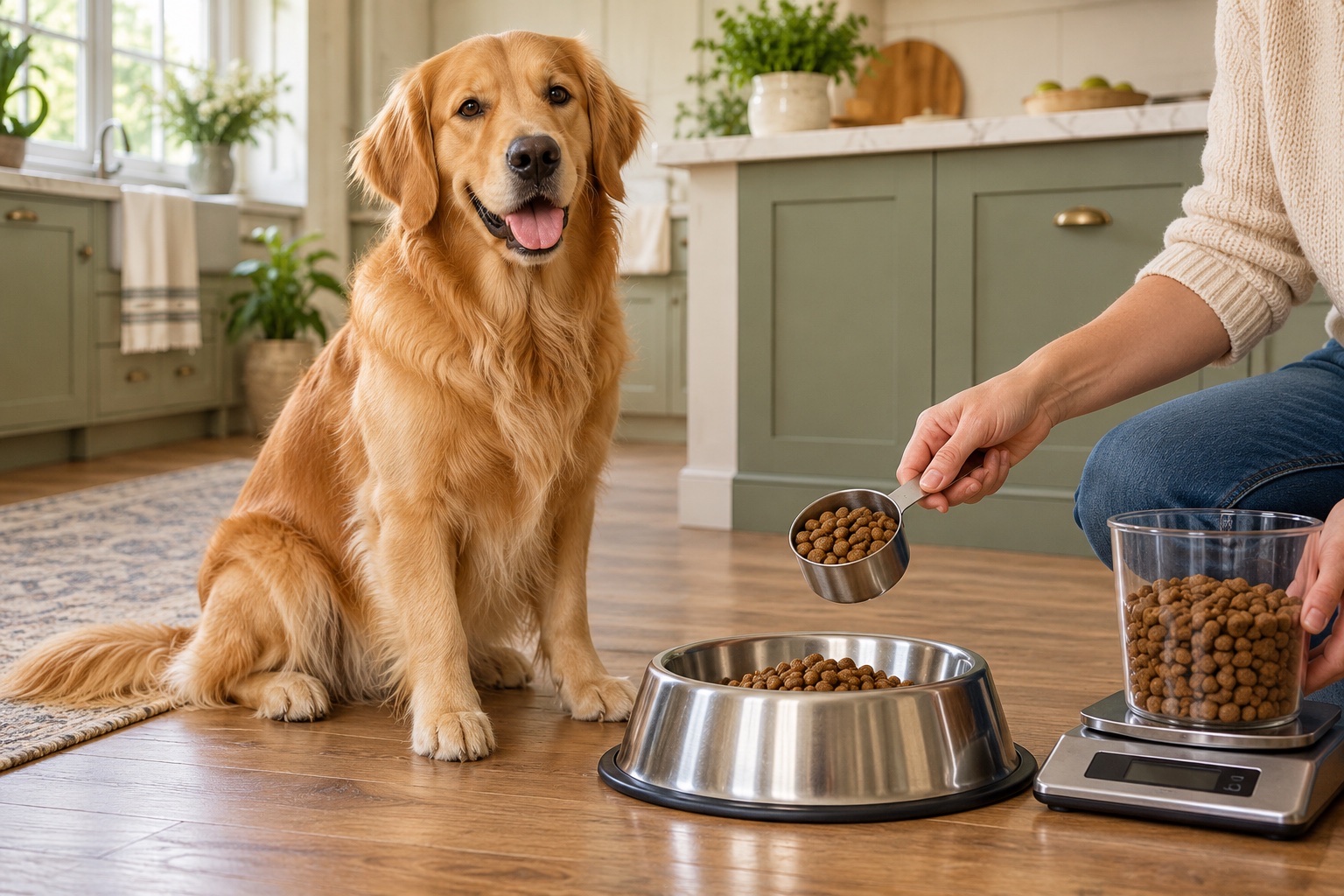
Begin with the food's stated metabolisable energy, usually expressed as kilocalories per kilogram, cup, can or pack. Weigh a typical scoop. Cups can vary with shape, settling and the hand holding them; grams are reproducible. Count treats, dental chews, training rewards and food used to hide medication.
Use our calorie calculator only as a starting estimate. Check weight every two to four weeks while changing portions. More importantly, assess body condition: ribs should be easy to feel, the waist visible from above and the abdomen tucked from the side. Your veterinarian can confirm a target and rule out misleading changes such as muscle loss.
Make meals feel larger without improvising nutrition
- Divide the daily ration into two or three meals rather than increasing the total.
- Use part of the measured meal for training instead of adding treats.
- Slow eating with a safe puzzle feeder, scatter feeding or short training session.
- Choose a complete diet with calorie density and fibre suited to the dog, with veterinary advice.
- Add water to a food when appropriate, but remember that volume does not change its nutrient balance.
- Replace random table scraps with weighed low-calorie rewards and keep extras below roughly ten percent of daily calories.
Use the Golden's enthusiasm
Food motivation is useful. Ten pieces of the normal ration can pay for recall practice, calm settling or nail handling. Basil would call that employment; the calorie ledger calls it breakfast.
When “always hungry” is a medical clue
Book a veterinary appointment if appetite rises suddenly or is paired with weight loss, increased thirst or urination, vomiting, diarrhoea, a pot-bellied appearance, weakness or coat changes. Diabetes mellitus, Cushing's syndrome, intestinal disease, parasites and some medications can increase hunger or alter weight. A dog taking corticosteroids may become ravenous even when calorie needs have not risen.
Also seek help if food-seeking becomes frantic, causes guarding or leads to scavenging dangerous objects. Behavioural management and medical assessment can be needed together.
Do fresh foods keep a Golden fuller?
Higher-moisture food usually provides more volume for the same calories than dry food. Some diets with appropriate fibre or protein profiles may improve satiety in particular dogs. That does not make every fresh recipe weight-loss food. Lamb, oil, skin, cheese and fatty mince can create a very energy-dense home-cooked bowl.
Homemade food must still be complete. Meat, rice and vegetables alone are usually calcium-poor and can miss multiple micronutrients. A dog can gain weight on a deficient diet. Read the calcium mistake most homemade recipes make before treating a larger-looking bowl as a healthier one.
Do not chase begging with bigger portions
Judge the plan by weight trend, body condition, health and the diet's nutritional adequacy. If your Golden is lean, healthy and still hopeful after dinner, the answer may be enrichment and consistency rather than more food.
A practical weekly routine
Pre-weigh each day's food into a container. Everyone in the household takes treats from that allowance. Record weight monthly and photograph the dog's shape from above and the side. If the waist fades, reduce calories cautiously with veterinary guidance and increase suitable activity. If weight falls despite strong appetite, contact the vet rather than celebrating the “easy diet.”
Goldens are persuasive because they are observant. Consistent rules are kinder than occasional large rewards: the dog learns that sitting by the pantry does not open it, while training and mealtimes remain predictable.
Sources
- Raffan E et al. A deletion in canine POMC is associated with weight and appetite in obesity-prone Labrador Retrievers.
- Raffan E et al. POMC deletion, hunger and energy expenditure in Labrador Retrievers.
- Wallis N et al. A canine genome-wide association study of obesity-related traits.
- Kealy RD et al. Effects of diet restriction on lifespan and age-related changes in dogs.
- WSAVA Global Nutrition Committee. Body Condition Score chart for dogs.
Veterinary note: Calorie targets are individual. Ask your veterinarian to assess weight, muscle and body condition before making a substantial restriction.