Key takeaways
- Grass eating is common in healthy dogs and usually is not followed by vomiting.
- In a large owner survey, only 9% of plant-eating dogs were frequently reported as ill beforehand and 22% frequently vomited afterwards.
- Hunger, time of day, habit and the simple appeal of grazing may all contribute.
- A sudden increase matters more than an occasional nibble, especially when it appears with vomiting, diarrhoea, pain, poor appetite or lethargy.
- Keep dogs away from treated lawns, toxic plants, sharp grass seeds and areas contaminated with faeces.
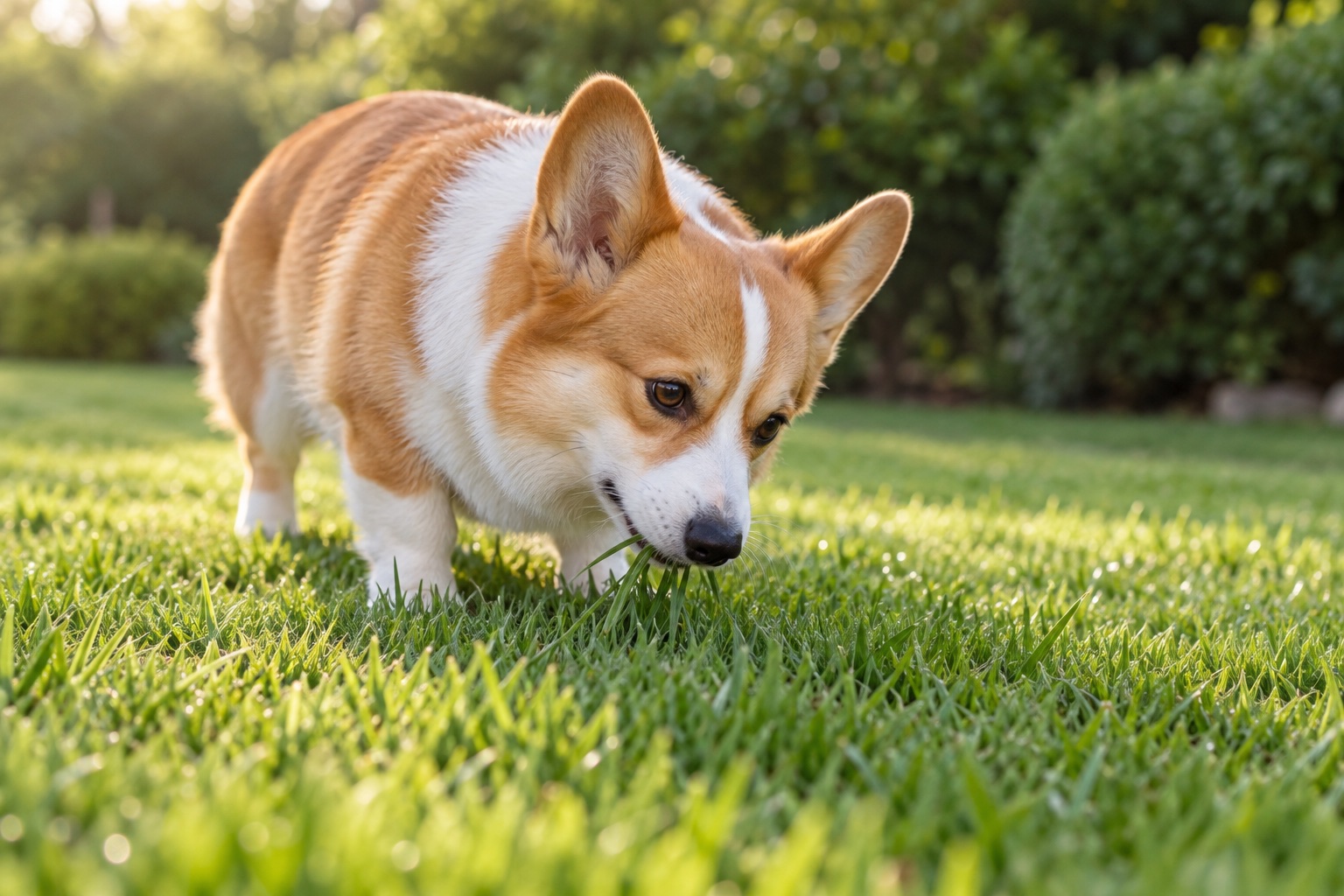
Basil sometimes investigates grass with the seriousness of a restaurant critic. He sniffs one patch, rejects it, then selects a single blade from another. The temptation is to turn that moment into a diagnosis: perhaps he feels sick, needs fibre or is trying to make himself vomit.
There is a simpler possibility. Many dogs eat plants because dogs commonly eat plants. Research has not found one explanation that fits every dog or every grazing session.
The vomiting story is much weaker than it sounds
The most useful study began with 47 healthy dogs that had daily access to plants. Seventy-nine per cent had eaten grass or other plants. The researchers then analysed 1,571 eligible responses from owners of plant-eating dogs. Grass was the most commonly eaten plant.
Only 9% of the dogs were frequently reported as appearing ill before eating plants, and only 22% frequently vomited afterwards. Younger dogs ate plants more often and were less likely to look ill beforehand or vomit afterwards.
🔬 What that study tells us
The findings fit grass eating as a common behaviour rather than a reliable sign of illness or a deliberate way to induce vomiting. They do not prove that nausea never triggers an individual dog to graze. Most of the information came from owner reports, so the study describes patterns and associations rather than a laboratory test of motive.
Myth
“Dogs eat grass because they need to vomit.”
More accurate
Some dogs vomit after grazing, but most dogs in the largest published survey did not frequently appear ill first or vomit afterwards.
What about an upset stomach?
A small controlled study tested whether mild digestive disturbance changed grass eating. Dogs were observed during a standard diet and during a diet supplemented with fructo-oligosaccharide, which produced loose stools. The dogs spent more time eating grass while producing normal stools. Across 374 grass-eating events, only two vomiting events occurred.
That result argues against dogs routinely using grass to self-medicate diarrhoea or to make themselves vomit. It does not answer every digestive question. Nausea, constipation and other gastrointestinal problems were not tested.
Read the controlled study on grass eating and mild gastrointestinal disturbance.
Hunger and timing may change the appeal
Earlier observations found that dogs were less likely to eat grass after they had eaten and that grazing decreased as the day went on. That makes hunger and time of day plausible influences. It does not mean every grass-eating dog is underfed.
Dogs also explore with their mouths. Grass moves, smells interesting and is readily available. A behaviour can continue because the dog enjoys it, because it fills quiet time or simply because it has become part of the walk.
Is it a fibre deficiency?
There is one published case report of a Miniature Poodle with years of daily plant eating and vomiting. The behaviour stopped after a change to a high-fibre diet. That is interesting, but one dog cannot establish that low fibre explains grass eating generally.
If your dog eats a complete commercial diet, do not add large amounts of fibre automatically. If you feed homemade food, the whole formulation matters. Fibre is only one part of nutritional adequacy, alongside amino acids, fatty acids, vitamins and minerals.
🥕 Look at the pattern before changing the bowl
Write down when the grazing happens, whether it occurs before breakfast, what the stool looks like and whether appetite or energy has changed. A short record is more useful to your veterinarian than a guess about one ingredient.
When grass eating deserves a vet call
Occasional relaxed grazing in an otherwise well dog is usually less concerning than a sudden, frantic or persistent change. Contact your veterinarian if grass eating occurs with:
- repeated vomiting or an inability to keep water down
- diarrhoea that is severe, bloody or persistent
- a swollen or painful abdomen, repeated retching or restlessness
- poor appetite, lethargy, weight loss or increased thirst
- repeated swallowing, drooling or obvious nausea
- eating large quantities of grass or other non-food material
A study of Belgian Shepherd Dogs found that grass eating was common in dogs with and without gastric disease and was not significantly associated with vomiting. The useful clue is the whole clinical picture, not grass eating in isolation.
Read the Belgian Shepherd gastric study.
The grass itself is not the only risk
⚠️ Check the lawn before your dog grazes
Do not let dogs eat vegetation recently treated with herbicide, pesticide or fertiliser. Avoid unknown plants, mouldy garden material and public areas contaminated with animal faeces. Sharp grass awns can also lodge in a dog's nose, ears, eyes, skin or paws.
The ASPCA recommends keeping pets away while garden products are applied and following the label before allowing them back. Its searchable plant database can help identify toxic plants, but suspected poisoning still needs prompt professional advice.
ASPCA garden safety advice · ASPCA toxic and non-toxic plant database
The practical answer
If your healthy dog occasionally samples clean, untreated grass and carries on with the day, observation is usually reasonable. You do not need to assume that every blade signals a nutritional gap or hidden illness.
What matters is change. A dog who suddenly grazes urgently while drooling, retching or refusing food is telling you something different from a dog who selects three blades during every morning walk. Watch the dog, not just the lawn.
Sources
- Sueda KLC, Hart BL, Cliff KD. Characterisation of plant eating in dogs. Applied Animal Behaviour Science. 2008.
- McKenzie SJ, Brown WY, Price IR. Reduction in grass eating behaviours in the domestic dog in response to a mild gastrointestinal disturbance. Applied Animal Behaviour Science. 2010.
- Kang BT et al. A high fiber diet responsive case in a poodle dog with long-term plant eating behavior. Journal of Veterinary Medical Science. 2007.
- Määttä OM et al. Gastric mucosal pathology in Belgian Shepherd dogs with and without clinical signs of gastric disease. 2021.
- ASPCA Animal Poison Control Center. Toxic and Non-Toxic Plants.
Veterinary note: This article is general information, not a diagnosis. Ask your veterinarian about new or persistent grazing, especially when it appears with digestive signs, pain, appetite change or unusual behaviour.