Key takeaways
- Food aroma matters, but smell alone does not predict every dog's final food choice.
- Dogs learn the sounds, places and routines that reliably lead to food.
- The famous stare can be communication: dogs alter food-seeking behaviour according to human attention and availability.
- Giving scraps during begging can strengthen the behaviour, even when rewards are occasional.
- Share a separately measured, dog-safe portion—not the seasoned food from your plate.
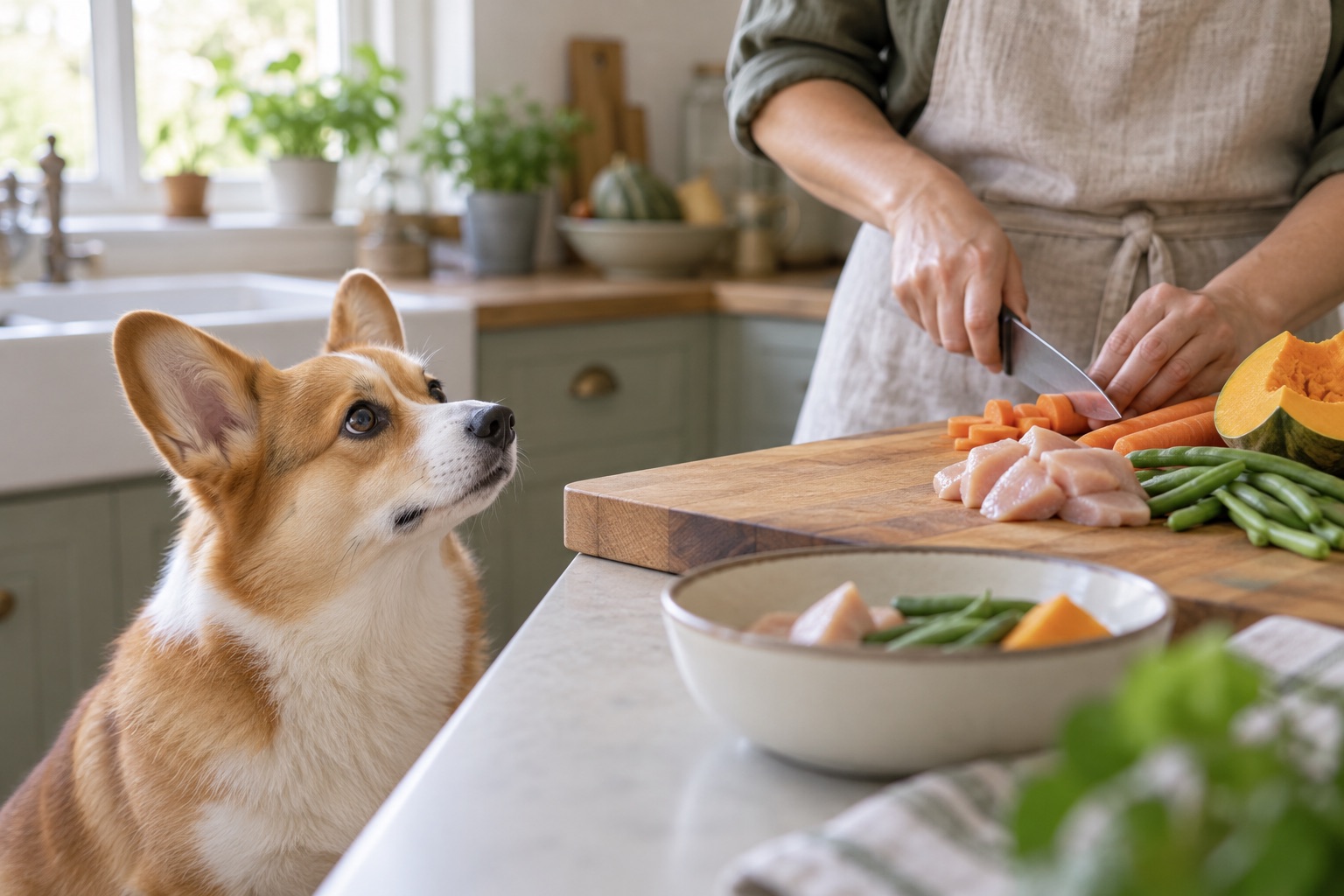
Basil can sleep through a delivery van, but the soft click of a vegetable drawer deserves immediate investigation. That is funny because a carrot is not especially aromatic. What he may be responding to is not the carrot itself, but a chain of familiar events: refrigerator opens, board appears, knife starts, food sometimes follows.
We often compress this into “dogs have an amazing sense of smell.” They do. But the kitchen stare is more interesting than that. Research suggests dogs combine information from the food, the room and us.
First, the nose gets a vote—not the whole decision
A dog's olfactory world is richer than ours, so aroma is an obvious place to begin. In a small pilot study, researchers used a two-port olfactometer to present food odours separately from the foods themselves. The dogs showed individual preferences, but their odour choices did not neatly predict which food they ultimately ate.
🔬 What the study can—and cannot—tell us
The experiment involved only six pet dogs, so it should not be treated as a universal law of canine taste. Its useful message is narrower: smelling a food and choosing to eat it are related but distinct behaviours. Texture, previous experience and the full eating context may also matter.
Read the full pilot study: Food and Food-Odor Preferences in Dogs.
This helps explain why a dog may race into the kitchen when chicken is cooking yet decline an unfamiliar bowl later—or why one dog prefers a food another ignores. “Smells strong” is not the same as “will definitely be eaten.”
Your kitchen is a collection of food predictions
Dogs are very good at learning sequences. The cupboard door, the scrape of a spoon and the place where you stand can become predictors of a meal. None of these cues needs to smell like food. They matter because of what has happened after them before.
If a dog receives chicken after hovering beside the chopping board, hovering has occasionally paid. Intermittent rewards can make a behaviour persistent: the next scrap might arrive after five quiet minutes—or after the twenty-first stare.
Myth
“My dog is begging because they must still be hungry.”
More accurate
Begging can reflect appetite, but it can also be learned food-seeking and social communication. Behaviour alone cannot tell you whether your dog's calorie allowance is inadequate.
This distinction is especially relevant for Labradors. A 2016 study found that a deletion in the POMC gene was associated with greater food motivation, weight and adiposity in the Labradors studied. The variant was not present in every Labrador, and the result does not mean every food-focused Lab has the mutation. It does show that biology can influence how strongly some dogs pursue food.
Read the full Labrador POMC study.
The stare is social, not just sensory
Dogs do not only monitor the meal. They monitor the person controlling access to it.
In one food-request experiment, dogs alternated their gaze between a desired food and their owner, and their signalling changed with the owner's body direction and with whether previous attempts had produced the whole reward, part of it or an undesirable food. The researchers interpreted this cautiously: the behaviour was consistent with intentional, referential communication, but learning from everyday interactions is also a plausible explanation.
Read the full study on dogs communicating about desirable food.
Another experiment found that dogs produced more facial movements when a person was attending to them. Importantly, the presence of food itself did not produce the same effect. That does not prove dogs consciously manufacture “puppy eyes” to manipulate us. It suggests their expressions are sensitive to an audience.
Read the Scientific Reports study on human attention and dog facial expressions.
So—is your dog manipulating you?
“Manipulation” makes a good headline, but it assumes an intention the experiments cannot read directly. A simpler explanation is that dogs repeat signals that have worked with humans. Looking, positioning the body, moving between a person and food, and appearing at the correct kitchen moment are efficient ways to request access.
Humans contribute too. We notice a silent stare, interpret it emotionally and sometimes reward it. The dog learns about us while we learn about the dog. That feedback loop can feel uncannily personal because it is personal: it has developed inside one household.
How to cook together without training a kitchen supervisor
You do not need to ban your dog from every food ritual. A consistent system is easier for both species.
- Choose a station. Teach a mat or bed outside the hot, crowded cooking zone.
- Reward the position, not the stare. If food is offered, deliver it for calm stationing rather than barking, pawing or jumping.
- Serve from the dog's bowl. Avoid passing food directly from the counter or dinner plate.
- Measure before seasoning. Remove the plain canine ingredients into a clean container before onion, garlic, salt, sauces or rich fats enter the human dish.
- Count shared food. A dog-safe ingredient still contributes calories.
🥧 Try the split-pan method
Our Chicken Pot Pie, Two Ways begins with shared plain prep. The dog's measured ingredients leave the workflow first; only then does the human filling receive onion, garlic, stock and pastry. It preserves the social pleasure of eating “together” without pretending both species should eat the same finished dish.
Why the finished human meal is often the unsafe part
Plain chicken, pumpkin or green beans may fit into a dog's diet. A finished casserole can contain several hazards at once: onion or garlic, concentrated stock, excessive fat and more calories than the owner realises. Bones and skewers add physical risk.
⚠️ Do not rely on “just one bite”
The safest habit is ingredient-level sharing, not plate-level sharing. The US Food and Drug Administration lists garlic, grapes, raisins, xylitol and several non-food household items among potential dangers for pets. If your dog eats something concerning, contact your veterinarian or an animal poison service promptly rather than waiting for symptoms.
The practical answer
Your dog watches you cook because the kitchen contains information. Food odours are part of it. So are learned routines, your body direction, your attention and a long history of what has happened after that look.
The stare does not automatically mean hunger, nutritional need or calculated deception. It means your dog has noticed a potentially rewarding situation and has a set of behaviours for asking about it. Basil's version happens to involve sitting exactly where the refrigerator light catches his ears.
If you want to share, make the rule simple: plain ingredients, measured portion, dog's bowl. Your dinner can still become pot pie. Your dog's dinner does not need to.
Sources
- Hall NJ et al. Food and Food-Odor Preferences in Dogs: A Pilot Study. Chemical Senses. 2017.
- Savalli C et al. Are Dogs Able to Communicate with Their Owners about a Desirable Food in a Referential and Intentional Way? PLoS ONE. 2014.
- Kaminski J et al. Human attention affects facial expressions in domestic dogs. Scientific Reports. 2017.
- Raffan E et al. A Deletion in the Canine POMC Gene Is Associated with Weight and Appetite in Obesity-Prone Labrador Retriever Dogs. Cell Metabolism. 2016.
- US Food and Drug Administration. Potentially Dangerous Items for Your Pet.
Veterinary note: Behavioural changes around food can occasionally accompany illness, medication effects or an unsuitable calorie intake. Ask your veterinarian about a sudden or marked change in appetite, thirst, weight or behaviour.