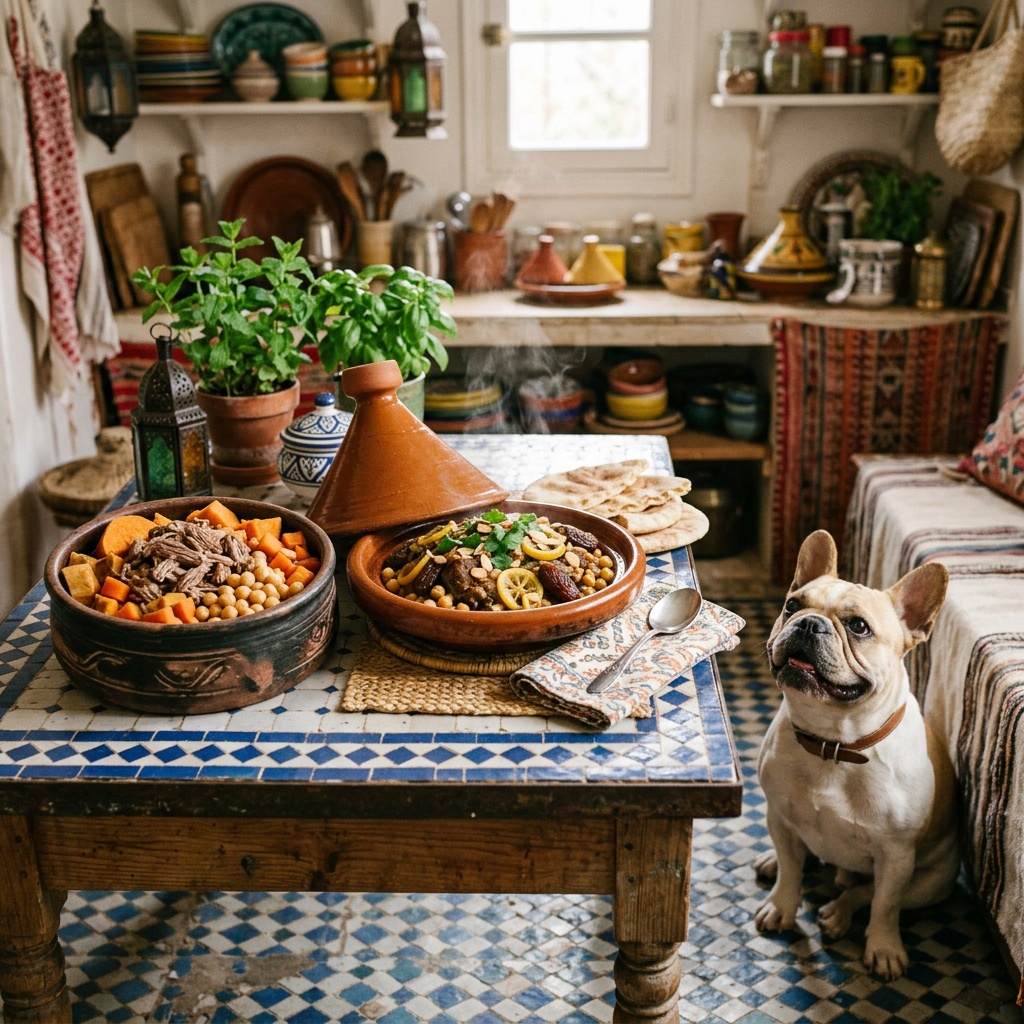
🐾 One Pot. The Same Lamb. Two Different Finishes.
This isn't two separate recipes. It's one slow-braised pot of lamb, sweet potato and chickpeas — and you cook it together for 90 minutes. At the end, you ladle out your dog's portion while the base is still plain. Then you finish yours with preserved lemon, harissa, garlic and salt. Your dog eats a genuinely delicious meal. You eat one of the great dishes of North African cooking. Same shopping list, same pot, one cleanup.
Lamb is rich and satisfying — excellent for most healthy adult dogs, but worth a second look for a few specific conditions. Check below before serving.
✅ Suitable for most breeds
The vast majority of healthy adult dogs do very well with lamb — especially dogs who've had issues with chicken or beef, since lamb is a less common protein and less likely to trigger sensitivities. Breeds including German Shepherds, Huskies, Golden Retrievers, Border Collies, Labradors, Rottweilers, Boxers, Dalmatians and most mixed breeds can enjoy this recipe exactly as written.
⚠️ Small adjustments needed
- Miniature Schnauzers, Cocker Spaniels, Yorkshire Terriers — prone to pancreatitis. Trim every visible gram of fat from the lamb shoulder and reduce olive oil to ½ tsp per serving. The lean lamb muscle itself is fine.
- Overweight dogs — reduce chickpeas and increase zucchini and carrots. Both are very low calorie and high in fibre.
- Giant deep-chested breeds (Great Dane, Irish Wolfhound, Weimaraner) — always split into two meals per day. Rest 45 minutes before and after eating.
- Dogs with oxalate urinary stones — chickpeas are moderately high in oxalates. Swap for cooked white rice or sweet potato.
❌ Not recommended
Dogs with confirmed lamb allergy — uncommon but possible. Signs include chronic skin irritation, itchy paws, ear infections and loose stools. Substitute with turkey or rabbit as a novel protein alternative.
Puppies under 6 months — designed for adult dogs. Puppies need substantially different calcium-to-phosphorus ratios and calorie density for safe bone development.
🥩Red Meat Protein
Lamb provides all essential amino acids plus iron, zinc and B12 — nutrients chicken simply can't match
🍠Beta-Carotene
Sweet potato is one of the richest plant sources of beta-carotene — converted to vitamin A for eyes, skin and immunity
🫘Plant Fibre & Protein
Chickpeas add soluble fibre for gut health and plant protein to complement the lamb
💛Anti-Inflammatory
Turmeric's curcumin has documented anti-inflammatory and antioxidant effects — especially useful for older dogs
🦴Calcium Balanced
Eggshell powder corrects the Ca:P imbalance created by any meat-heavy meal
🐟Omega-3 Cold
Salmon oil added after cooling provides EPA and DHA — the omega-3s lamb cannot supply
Based on feeding ~2–2.5% of body weight daily. Adjust for your dog's activity level and current condition. If feeding twice a day, split these amounts in half per meal.
🥩Lamb ShoulderComplete Protein • Iron • Zinc • B12 • Taurine
Lamb is one of the most nutrient-dense meats you can feed a dog. It's rich in iron (far more than chicken), zinc for immune function, and vitamin B12 for nerve health. Shoulder has more fat than leg — which is great for energy and palatability, but trim it well if your dog is pancreatitis-prone. Lamb is also a common "novel protein" choice for dogs with chicken or beef sensitivities.
⚠️ Trim visible fat for pancreatitis-prone breeds. Never feed cooked lamb bones.
🍠Sweet PotatoBeta-Carotene • Vitamin A • Potassium • Fibre
Sweet potato is one of the most nutritionally well-rounded vegetables you can feed a dog. It's rich in beta-carotene (converted to vitamin A for vision, skin and immunity), potassium for heart and muscle function, vitamin C, B6 and significant dietary fibre that supports a healthy gut microbiome. The natural sweetness makes it highly palatable for picky eaters. Always cook thoroughly — never raw.
🫘Chickpeas (Cooked)Plant Protein • Soluble Fibre • Folate • Manganese
Cooked chickpeas add a genuinely useful nutritional layer — plant protein to complement the lamb, soluble fibre that feeds beneficial gut bacteria, folate for cell production and manganese for bone formation. They also add satisfying bulk at low calorie cost, which makes them excellent for food-motivated or weight-managing dogs. Use well-cooked chickpeas only — raw or undercooked are hard to digest and can cause significant gas.
💛TurmericCurcumin • Anti-Inflammatory • Antioxidant • Joint Support
The curcumin in turmeric has extensive research support for anti-inflammatory and antioxidant effects. This is especially relevant for older dogs, working dogs, or any dog with early joint issues. The ¼ tsp for the whole pot is a meaningful dose — small enough to be safe, large enough to provide benefit. The fat from olive oil in this recipe significantly increases curcumin absorption (it is fat-soluble).
🥕CarrotsBeta-Carotene • Prebiotic Fibre • Vitamin K • Low Calorie
Carrots are one of the best all-round vegetables for dogs. Cooked carrots are highly digestible and provide beta-carotene, vitamin K and a form of fibre (pectin) that acts as a prebiotic — selectively feeding beneficial gut bacteria. Low in calories, high in volume. Excellent for weight management and digestive regularity. Slow cooking makes them very easy on sensitive stomachs.
🥒ZucchiniVitamin C • Potassium • Very Low Calorie • Hydration
Zucchini is almost entirely water and micronutrients — which makes it the perfect bulk vegetable for dogs that need volume to feel satisfied without the calories. It provides vitamin C, potassium and a small amount of fibre. Because it has essentially no flavour of its own, it disappears into the tagine without altering the taste. A genuine free food for overweight dogs.
🫚Olive OilOleic Acid • Omega-9 • Anti-Inflammatory • Fat-Soluble Vitamin Carrier
The fat that Moroccan cooking is built on — and it's genuinely good for dogs too. Olive oil's primary fatty acid (oleic acid, omega-9) has documented anti-inflammatory properties and supports cardiovascular health. Critically, it's also the carrier that allows fat-soluble vitamins (A from sweet potato and K from coriander) to actually be absorbed. Without some fat in the meal, these vitamins pass straight through.
🌿Fresh Coriander or ParsleyVitamin K • Vitamin C • Chlorophyll • Natural Antimicrobial
A small amount of fresh herb adds genuine nutritional value — not just flavour. Coriander (cilantro) provides vitamin K for blood clotting, vitamin C as an antioxidant, and has mild antimicrobial properties. Flat-leaf parsley is an excellent alternative. Use the amounts shown — herbs are not a daily supplement, they're a flavourful finishing touch that happens to be nutritious.
⚠️ Use the leaf only. Avoid the stems in large quantities. Do not use dried herb powders — much higher concentration.
🥛Eggshell Calcium PowderCalcium Carbonate • Ca:P Balance • Bone Health
Lamb is very high in phosphorus and almost devoid of calcium. Every meat-based homemade meal has this imbalance — and if you never correct it, the body compensates by drawing calcium from bone over time. Eggshell powder (pure calcium carbonate) is the simplest, most bioavailable fix. It corrects the ratio to approximately 1.2:1 per NRC guidelines. Always add cold, after cooking.
🐟Salmon or Sardine Oil (cold)EPA & DHA Omega-3 • Coat • Brain • Joint • Heart
The single most important finishing step. Lamb provides excellent protein and iron but almost zero EPA or DHA. Adding cold fish oil every meal fills that nutritional gap completely. DHA supports brain function and cognitive health — important as dogs age. EPA reduces systemic inflammation, which matters for joints, skin and gut health. Add cold every meal without exception. Refrigerate the bottle and use within 4–6 weeks of opening.
🐕 Featured Breed: Sloughi (The Arabian Greyhound of Morocco)
The Sloughi is one of the world's oldest dog breeds — a North African sighthound that has hunted alongside Berber and Arab peoples across Morocco, Tunisia, Algeria and Libya for at least 3,000 years. Lean, elegant and extraordinarily fast, the Sloughi was historically so valued that it was allowed inside the tent, slept with the family, and ate with them at mealtimes. This recipe is as close to that tradition as a modern home kitchen can get.
- Extremely lean physique — the Sloughi carries almost no body fat by design. They need adequate protein and fat to maintain muscle and coat, but the lamb in this recipe (especially if trimmed) fits their naturally lean metabolic profile better than heavily fatty cuts.
- Sensitive digestive system — Sloughis are well-known for having sensitive stomachs and can be difficult to feed. The simplicity of this recipe — lamb, sweet potato, chickpeas, gentle spices — is exactly the kind of whole-food approach that works well with sensitive breeds. No artificial additives, no complex ingredient lists.
- Joint longevity for coursing dogs — a running breed takes serious cumulative joint impact. The turmeric's curcumin and the fish oil's EPA/DHA in this recipe both directly target joint inflammation and cartilage health over time. These are not optional for active sighthounds.
- Historically lamb-fed — in Morocco and North Africa, lamb is the primary meat. Goat and camel follow. Chicken is relatively recent. The Sloughi's ancestral diet was literally built on lamb over millennia — this recipe is as ancestrally appropriate as it gets.
- High EPA/DHA requirement for coat — the Sloughi's short, close coat requires good essential fatty acid intake to maintain its gloss and skin health. The salmon oil added cold per serving is directly relevant to coat condition in this breed.