Key takeaways
- A high price does not prove nutritional adequacy, digestibility, safety or better health outcomes.
- “Premium,” “holistic” and many packaging claims have limited nutritional meaning.
- Start with the nutritional adequacy statement, life stage, calories and manufacturer expertise.
- An ingredient list cannot show ingredient quality or whether the finished nutrient profile is appropriate.
- The best food is complete, suitable, safely made, affordable enough to feed consistently and successful for the individual dog.
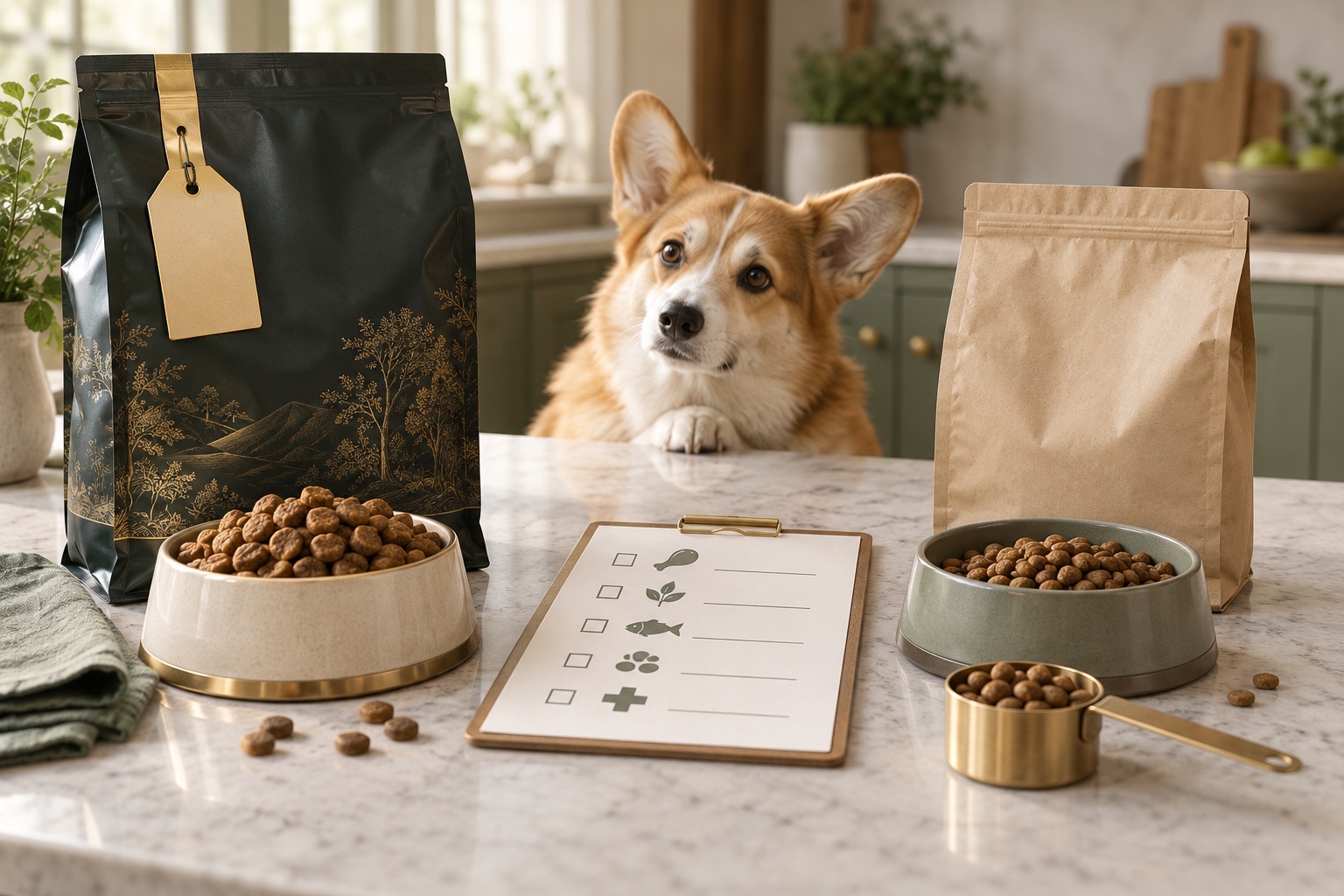
Dog food shopping is designed to make you compare identities, not data. One bag evokes a farmhouse. Another looks like laboratory equipment. A refrigerated pack resembles a human ready meal. Price becomes a shortcut: if it costs twice as much, surely it must be twice as good.
Nutrition does not scale that neatly. Cost reflects ingredients, freight, packaging, refrigeration, marketing, retail margin, production volume and research. Some of those expenses can improve a food. Others improve only the experience of buying it.
Begin with what the food promises to provide
In the United States, a “complete and balanced” statement indicates that a food is intended to supply all required nutrients in appropriate proportions for the stated life stage. The label should say whether adequacy was established by formulation to an AAFCO nutrient profile or by an AAFCO feeding-test protocol. Foods labelled for intermittent or supplemental feeding should not quietly become the sole diet.
This statement is not a quality trophy. It is the minimum doorway. A luxury topper can be unsuitable as a main diet, while a modest supermarket food may meet an adult maintenance profile. Puppies, especially expected large adults, need the correct growth statement.
Why the ingredient list is a poor ranking system
Ingredients appear by weight before cooking. Water-rich meat can sit above a dry protein meal even when it contributes less concentrated protein after processing. Splitting related ingredients into several names can move each down the list. The list does not show amino-acid balance, bioavailability, contaminant testing or batch consistency.
By-products are often treated as evidence of low quality, yet the term can include nutrient-rich organs. Conversely, a list of ingredients you would happily eat can still create calcium, trace-mineral or vitamin deficiencies if the formula is poorly designed. “No fillers” is advertising, not a defined nutritional endpoint.
Ingredients supply nutrients; dogs require nutrients
The finished food must deliver usable protein, fat, vitamins and minerals in the right amounts and ratios. An attractive ingredient can be useful, unnecessary or excessive depending on the complete formula.
What you may reasonably pay more for
- Qualified nutritionists involved in formulation and ongoing review.
- Owned manufacturing or close oversight of contracted plants.
- Supplier standards, contaminant testing and finished-product analysis.
- Research, digestibility work and feeding trials relevant to the product.
- Reliable customer service that can provide typical nutrient analysis and calorie information.
- Therapeutic formulation for a diagnosed condition, prescribed and monitored by a veterinarian.
These practices cost money. The important point is to ask whether they exist, not to infer them from price. WSAVA's pet-food selection questions focus on expertise, quality control and research rather than endorsing brands or ingredient fashions.
What price cannot tell you
A high price cannot establish that one food prevents cancer, extends life, reduces inflammation or improves immunity. Those are health claims requiring appropriate studies. Testimonials and before-and-after photographs do not control for calorie intake, previous diet, treatment or chance.
Novel proteins, ancient grains, air drying and freeze drying may serve particular purposes, but novelty is not evidence of superiority. Boutique production can offer care and transparency; it can also operate with fewer technical resources. Large companies may have research and quality systems; size alone is not a guarantee either.
Feeding trials: useful, not magical
AAFCO feeding-test protocols provide evidence that animals ate the food for a defined period while meeting specified clinical criteria. That is more information than formulation on paper alone, but it is not a lifetime trial and does not prove superiority over every alternative. “Feeding trial” should be read as one piece of evidence.
Similarly, laboratory nutrient analysis confirms what was measured in samples, while formulation software predicts from ingredients. Strong manufacturers use multiple layers: formulation expertise, supplier controls, process checks, finished-product testing and complaint investigation.
Calculate cost per day, not per bag
A dense dry food may require a smaller portion than a wet food. A fresh food contains much more water, so price per kilogram is not directly comparable. Find the kilocalories your dog eats daily and calculate the daily cost. Then include treats, toppers and supplements.
Overfeeding an expensive food does not make it healthier. Underfeeding to make the pack last can short-change essential nutrients. Use the stated calories, weigh portions, and monitor body condition with your veterinarian.
Seven questions worth asking
- Is it complete and balanced for this life stage?
- Who formulated it, and what are their qualifications?
- Where is it made, and who controls the process?
- Is the finished product analysed?
- What is the typical nutrient analysis and calorie density?
- What research supports the claims?
- Can the company answer clearly when you contact them?
Where homemade food fits
Home cooking is not automatically cheap or expensive, and it is not automatically superior. Meat and vegetables may look excellent while lacking calcium, iodine, vitamin D, vitamin E, copper, zinc or essential fatty acids. Supplements and professional formulation are part of the real cost. Our calcium guide explains why a spoon of eggshell does not close every gap.
Do not turn affordability into shame
A food that meets nutritional needs, fits the dog's health, is handled safely and can be purchased consistently is a responsible choice. Owners should not be made to feel that love is measured by refrigerated packaging or exotic meat.
The quiet evidence in your own dog
Once the fundamentals are sound, watch weight, body and muscle condition, stool, skin, coat, appetite and veterinary findings. A diet can be reputable and still not suit every individual. Persistent diarrhoea, itching, weight change or poor appetite deserves assessment rather than repeated brand-hopping.
The best buying decision is wonderfully unglamorous: verify adequacy, ask about the people and systems behind the food, ignore claims that outrun evidence, and choose something you can feed accurately every day.
Sources
- WSAVA Global Nutrition Committee. Selecting a pet food for your pet.
- FDA. “Complete and balanced” pet food.
- AAFCO. How to read a pet food label.
- AAFCO. Selecting the right pet food.
- Freeman LM et al. Recommendations on selecting pet foods.
Veterinary note: Medical diets and substantial feeding changes should be discussed with your veterinarian.