Key takeaways
- For the claim to apply to the whole product, all ingredients and the entire production process must meet the applicable human-food requirements described by AAFCO guidance.
- Human-grade and complete-and-balanced answer different questions.
- Small studies of specific human-grade foods report high digestibility and lower faecal output, but do not prove longer life or protection from disease.
- Results from one company's recipes cannot be assigned to every product using the claim.
- Assess adequacy, formulation expertise, quality control, calories and suitability before giving the front label much weight.
The phrase “human-grade” feels reassuring because it invites a simple mental picture: food good enough for us must be especially good for a dog. The regulatory reality is narrower. The claim concerns the status of ingredients and the way the product is manufactured, packed and held. It is not a clinical verdict.
What human-grade means
AAFCO's guidance requires every ingredient in a product making a whole-product human-grade claim to be human edible, and the product must be made, stored and handled in compliance with the relevant human-food regulations. A product does not become human-grade because it contains chicken breast or carrots. The facility and every step in the chain matter.
The term is also different from “made with human-grade ingredients.” If other ingredients or processing steps do not qualify, a broad claim about the finished food can be misleading. Regulatory acceptance and wording vary by jurisdiction, so the label should not be treated as universal shorthand.
Two independent questions
Human-grade: were ingredients and processes eligible for the claim? Complete and balanced: does the food supply all required nutrients in appropriate proportions for the stated life stage? A food can satisfy one question without satisfying the other.
Why recognisable ingredients can still miss nutrients
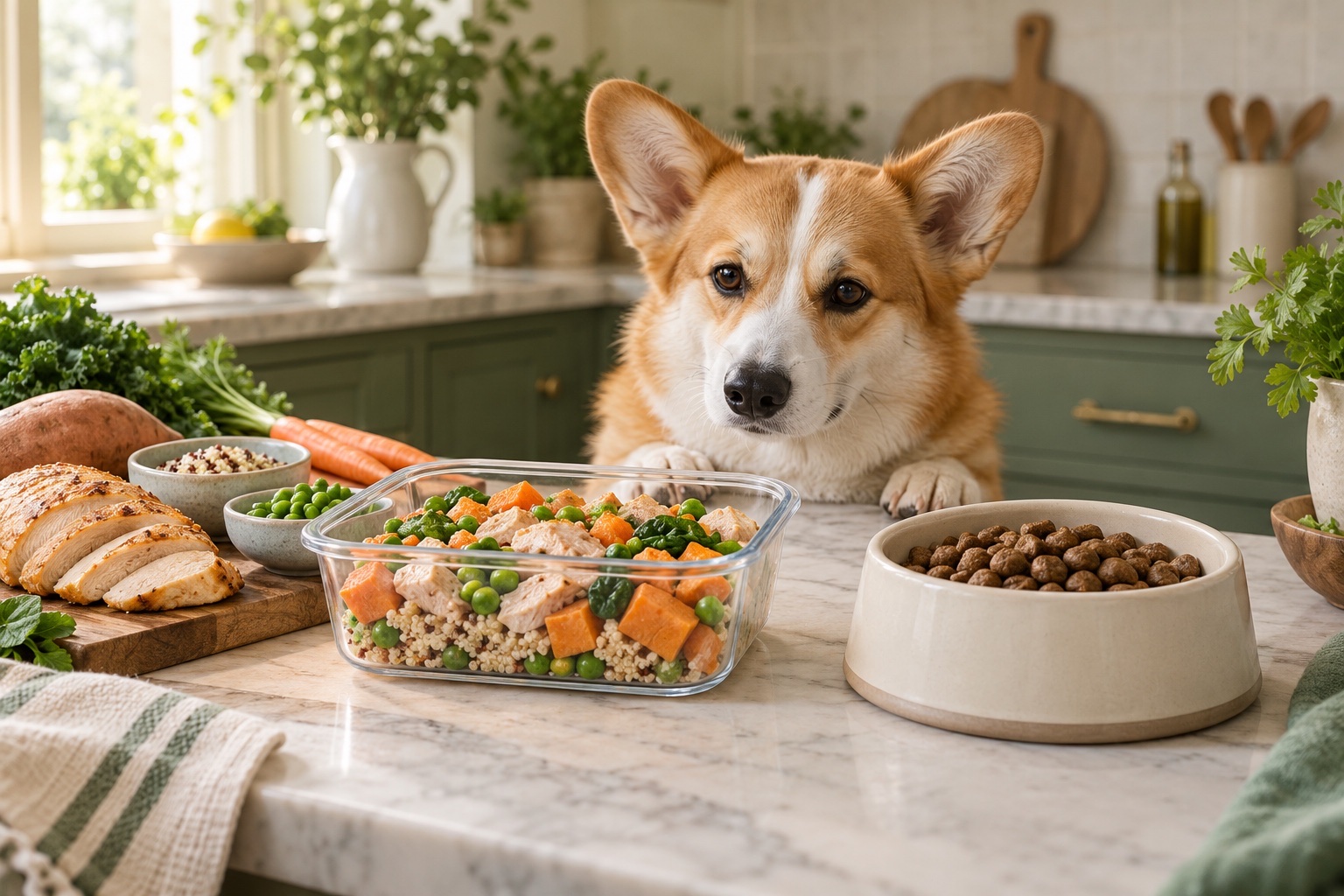
A bowl of cooked chicken, potato, peas and carrot may look more wholesome than kibble. Dogs, however, need nutrients that are not visible in a photograph. Boneless meat provides phosphorus but little calcium. Iodine, vitamin D, vitamin E, copper, zinc, manganese and essential fatty acids can also fall short in unformulated recipes.
A commercial human-grade food intended as the main diet should carry an appropriate nutritional adequacy statement. A topper, treat or food labelled for intermittent or supplemental feeding is not a sole diet, no matter how appetising it looks. For home cooking, a recipe needs dog-specific formulation, not merely supermarket ingredients. Our calcium guide explains one of the most common gaps.
What the digestibility studies found
In a controlled study of 12 healthy adult Beagles, two cooked human-grade diets were compared with one fresh diet and one extruded diet. The human-grade foods had higher apparent total tract digestibility for several macronutrients and produced less faecal output than the extruded diet. Stool scores were acceptable across all diets, and most blood values remained within reference ranges.
Another experiment using a rooster assay reported high amino-acid digestibility for six complete human-grade dog foods. Those foods had passed AAFCO feeding trials. These results support the narrower statement that the tested formulas were digestible and nutritionally adequate for their intended use.
They do not establish that “human-grade” itself caused the result. The diets differed in ingredients, fibre, fat, moisture and processing, not only regulatory status. Twelve dogs in short crossover periods cannot reveal lifetime cancer risk, kidney health or longevity.
Skin, coat, microbiome and gene-expression research
A small study comparing a mildly cooked human-grade food with an extruded food measured faecal microbes, blood gene expression, skin and coat outcomes. It reported changes in microbiome and gene expression, while many claimed consumer benefits remain unsubstantiated. Mechanistic signals can guide future research, but a shifted microbial community is not automatically a healthier dog.
Commercial funding is common in nutrition research and does not invalidate a study. It does mean readers should inspect the design, comparator, sample size, duration, outcomes and author disclosures rather than relying on the abstract's mood.
Does less processing mean healthier?
Processing is not a single dose of harm. Cooking can reduce pathogens and improve starch digestibility. It can also lower some heat-sensitive vitamins, which a properly formulated diet accounts for. Refrigeration and freezing require an unbroken cold chain. Extrusion, canning and mild cooking each create different trade-offs.
“Minimally processed” has intuitive appeal, but its health meaning depends on the actual process and finished nutrient profile. Our article Does cooking destroy nutrients in dog food? looks at heat, water and retention in detail.
Questions to ask a human-grade company
- Is this specific recipe complete and balanced, and for which life stage?
- Who formulated it, and what are their veterinary-nutrition qualifications?
- Was adequacy established by formulation, feeding trial or both?
- What finished-product and pathogen testing is performed?
- Can the company provide typical, not only minimum and maximum, nutrient values?
- What is the calorie content per gram or pack?
- How should it be transported, refrigerated, frozen and discarded?
- What published research concerns this exact product rather than the category?
Judge the food your dog actually eats
Compare cost per day, calorie density, storage burden and waste. Then watch weight, body and muscle condition, stool and veterinary findings. A label cannot replace follow-up.
Potential advantages without overclaiming
A well-made human-grade food may offer high palatability, useful moisture and a format some owners find easier to portion or trust. Specific formulations may be highly digestible. Those are legitimate reasons to choose one when it is complete, appropriate and affordable.
They are not evidence that all human-grade food prevents disease or extends life. Homemade food made from human-edible groceries may be nutritionally incomplete. A complete conventional food may have deeper feeding data and quality-control systems than a costly refrigerated newcomer.
The claim is not a halo
Human-grade does not mean organic, locally sourced, free-range, preservative-free, minimally processed, veterinary-formulated or suitable for every dog unless those separate facts are established. It also does not make a product safe to eat from your dog's bowl.
The bottom line
Human-grade is a meaningful sourcing and process claim when used correctly. It can coexist with excellent nutrition, but it does not create excellent nutrition. The evidence supports high digestibility for some tested products. Evidence for superior long-term health or lifespan across the category is not established.
Choose the formula, not the aura: correct life stage, complete nutrient profile, qualified formulation, robust manufacturing, accurate calories and a good result in the dog standing beside you.
Sources
- AAFCO. Guidelines for Human Grade Pet and Specialty Pet Food Claims.
- Oba PM et al. Nutrient digestibility and faecal characteristics in dogs fed human-grade foods.
- Oba PM et al. True nutrient and amino-acid digestibility of dog foods made with human-grade ingredients.
- Do S et al. Mildly cooked human-grade diet, gene expression, skin, coat and faecal microbiota.
- FDA. “Complete and balanced” pet food.
- WSAVA. Selecting a pet food for your pet.
Veterinary note: Ask your veterinarian before changing diets, especially for growth, pregnancy or a medical condition.