The decision to switch to homemade food is a good one. Research consistently shows that dogs fed fresh, whole-food diets have better coat condition, healthier weight, improved digestion, and often greater energy and vitality compared to dogs on standard commercial kibble. But the transition itself — how you get from one to the other — matters a great deal.
Most owners who try to switch abruptly end up with a dog suffering loose stools, gas, or vomiting within 24 hours, and conclude that homemade food "doesn't agree" with their dog. In almost every case, the food is not the problem. The transition method is. This guide walks you through the right approach, what to expect, and how to set your dog up for a smooth switch.
Why You Cannot Switch Overnight
A dog's digestive system is not just a tube — it is a carefully balanced ecosystem. The gut microbiome (the trillions of bacteria that process food) is calibrated to the dog's current diet. A dog eating kibble has a gut bacterial community that is optimised for breaking down that specific food. When the diet changes suddenly, those bacteria are unprepared, enzyme production does not match the new food type, and the result is digestive upset.
Think of it this way: if you ate only processed food for years and then suddenly switched to a diet of fresh whole foods overnight, your gut would also struggle for a few days. The biology is comparable. The solution is not to avoid the change — it is to make it gradually so the gut can adapt.
ℹ️ What Actually Changes in the Gut
Kibble is high in starch and low in moisture. A homemade diet is lower in starch, higher in moisture, and often higher in protein and fat. The gut needs to upregulate its production of proteases (protein-digesting enzymes) and lipases (fat-digesting enzymes) to handle the shift. This enzymatic adjustment takes roughly 5–7 days. The gradual transition gives the gut exactly that time window.
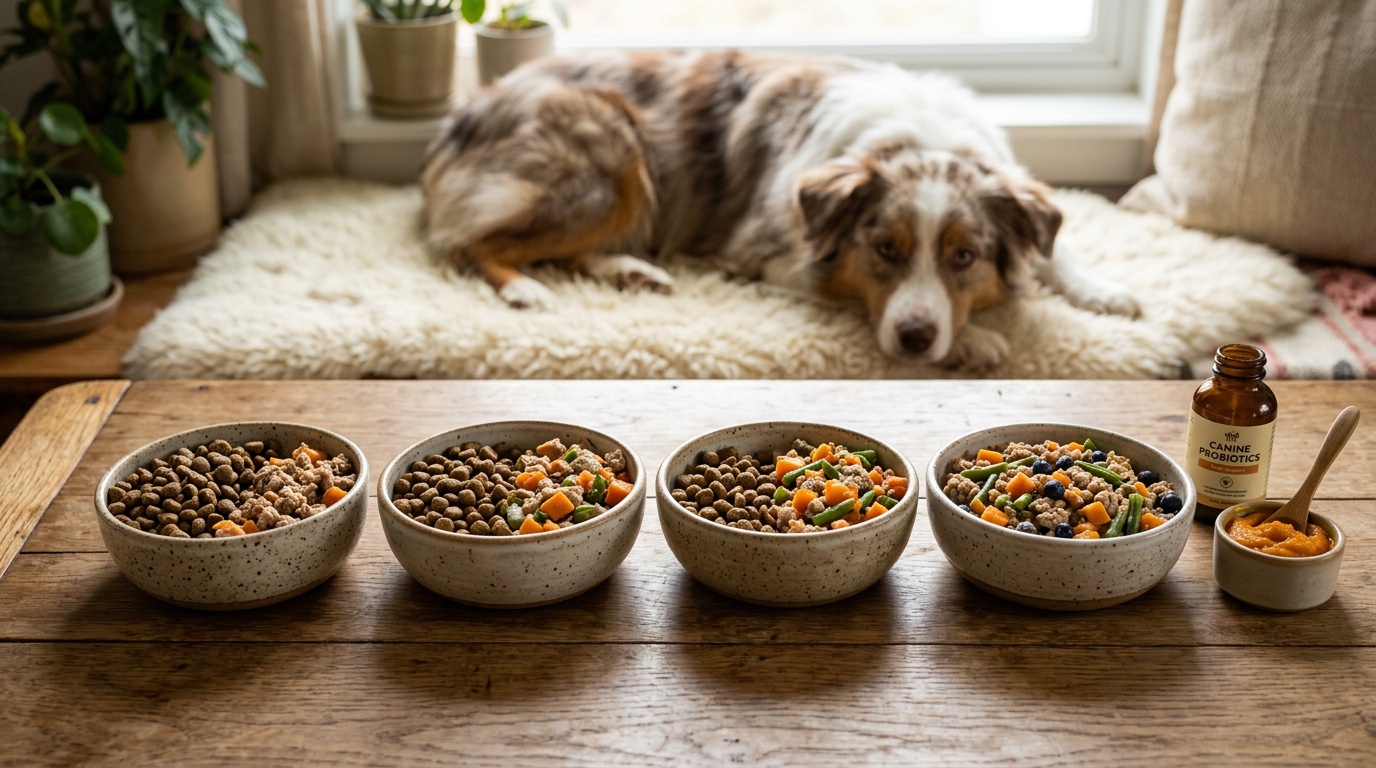
The 10-Day Transition Plan
This is the approach used by most veterinary nutritionists and endorsed in homemade feeding guidelines. It works for the vast majority of dogs. Dogs with sensitive stomachs or a history of digestive issues should extend this to 14–21 days.
What Is Normal — and What Is Not
Some digestive changes during transition are completely expected. Others are a signal to slow down or seek veterinary advice.
- Softer stools or slightly loose stools in the first 3–5 days
- Increased gas, especially in the first week
- Stools changing colour (darker with beef, lighter with chicken) — reflects new ingredients
- Increased thirst — homemade food has higher moisture so this usually decreases over time
- Mild borborygmus (stomach gurgling) that resolves within a few days
- Vomiting more than once or twice in the first few days
- Watery diarrhoea lasting more than 3 days
- Blood in stools at any point
- Dog is lethargic, refuses food, or shows signs of abdominal pain
- Significant weight loss in the first two weeks
If any of the red-flag symptoms appear, go back to the previous ratio (or back to 100% kibble if needed), let the gut settle for 3–5 days, and then try the transition again more slowly. Persistent issues warrant a vet check — occasionally there is an underlying gut condition that the transition has uncovered.
The Best First Recipes for Transition
The first homemade meals you introduce should be simple and gentle. Save the more adventurous recipes for after the transition is complete and the gut has settled.
Start With a Single Protein — Chicken or Turkey
Lean poultry is the easiest protein for a transitioning gut to handle. It is low in fat, highly digestible, and unlikely to trigger reactions. Plain boiled chicken breast or thigh (no seasoning, no onion, no garlic) mixed with well-cooked rice or sweet potato is the classic starting point used by vets after illness — for good reason. Keep the first few homemade meals simple: one protein, one starch, one or two cooked vegetables.
Add Pumpkin if Stools Loosen
Plain canned pumpkin (not pumpkin pie filling — just pure pumpkin) is a soluble fibre powerhouse. One to two teaspoons per meal for small dogs, one to two tablespoons for larger dogs, can firm up loose stools during the transition period without impeding the process. It also acts as a prebiotic, supporting the growth of beneficial gut bacteria during the microbiome adjustment.
Consider a Probiotic for the First 2–3 Weeks
A canine-specific probiotic supplement introduced at the start of the transition can meaningfully reduce the duration and severity of digestive adjustment symptoms. Look for strains specifically validated in dogs: Lactobacillus acidophilus, Bifidobacterium animalis, and Enterococcus faecium. Fortiflora (by Purina) is widely available and vet-recommended for exactly this purpose. Continue for 2–3 weeks through and after the transition.
Supplements to Add From Day One
The moment you start including any homemade food in your dog's meals, two supplements need to go in with every homemade portion. These are not optional extras — they correct the most critical nutritional gap in all meat-based diets.
🦴 Eggshell Calcium — Add Cold to Every Homemade Meal
Meat is naturally very high in phosphorus and very low in calcium. Without correction, a meat-heavy diet will gradually deplete bone calcium. The fix: finely ground eggshell powder, stirred in cold after the food has cooled — never cooked in. Dose: ¼ tsp per meal for dogs under 10kg, ½ tsp for 10–25kg, ¾ tsp for 25–40kg, 1 tsp for larger dogs. Scale the dose to the proportion of homemade food in the bowl — so at 50/50, use half the full dose.
🐟 Fish Oil — Add Cold to Every Homemade Meal
Whole foods cannot reliably provide the EPA and DHA omega-3s dogs need without regular oily fish. Fish oil fills this gap. Always stir in cold after the food has cooled — heat destroys EPA and DHA completely. Dose: ½ tsp for under 10kg, 1 tsp for 10–25kg, 1½ tsp for larger dogs. Again, scale to the homemade proportion during transition.
Once the transition is complete and you are feeding 100% homemade, also begin rotating beef liver in 2–3 times per week. Liver provides selenium, copper, zinc, vitamin D, and B12 in one ingredient — nutrients that are hard to reliably cover with muscle meat alone. Keep it to no more than 10% of total food volume to avoid vitamin A accumulation.
Breed-Specific Transition Notes
Some breeds need a slower or more carefully managed transition than others.
Signs the Transition Is Going Well
- Firm, well-formed stools within 5–7 days of starting the transition
- Consistent or improved energy levels — not lethargic or hyperactive
- Enthusiasm at mealtimes — most dogs are far more excited about homemade food than kibble
- No vomiting and no blood in stools throughout the entire process
- Stable or slightly improved weight — if weight drops more than 5%, portion sizes need to increase
- Coat beginning to soften within 4–6 weeks of full transition — one of the earliest visible signs of improved nutrition
📏 How Much Homemade Food to Feed?
A common starting guideline is 2–3% of body weight per day in fresh food (for adult dogs at maintenance weight). So a 20kg dog would eat approximately 400–600g of food daily, split into two meals. This is a starting point — monitor your dog's weight and adjust up or down over the first few weeks. Our Calorie Calculator gives you a more precise figure based on your dog's breed, age, and activity level. The Recipe Generator also provides weight-specific portion sizes with every recipe it creates.
Frequently Asked Questions
How long does it take to transition a dog from kibble to homemade food?
The standard recommendation is 10 days, gradually increasing the proportion of homemade food while reducing kibble — starting at 25% homemade and 75% kibble, moving to 50/50, then 75% homemade, and finally 100% by day 10. Dogs with sensitive stomachs or digestive conditions may need 2 to 3 weeks.
Why does my dog have diarrhoea when switching to homemade food?
Loose stools during the first few days are very common and usually not a cause for concern. A dog's gut microbiome is calibrated for its current diet. When the diet changes, the microbiome needs time to adjust. Slowing the transition down and adding a small amount of pumpkin puree (1–2 teaspoons per meal) can help firm stools during the adjustment period. If diarrhoea is watery or lasts more than 3 days, slow the transition or return to the previous ratio.
Can I switch my dog to homemade food overnight?
Not recommended for most dogs. An abrupt switch can cause digestive upset including vomiting, diarrhoea, and gas — not because homemade food is problematic, but because the gut needs time to adjust its enzyme production and microbial balance. A gradual 10-day transition prevents this and makes the switch far more comfortable for the dog.
What supplements do I need to add when switching to homemade food?
From day one of feeding any homemade meal, two supplements are essential: eggshell calcium powder (to correct the Ca:P imbalance in meat-based diets) and fish oil for omega-3 EPA and DHA. Both must be added cold after the food has cooled — never cooked in. A vet-formulated supplement like Balance IT Canine can replace both and cover additional micronutrient gaps. Once fully transitioned, rotating beef liver in 2–3 times per week covers selenium, zinc, copper, and B12.
My dog refuses the homemade food. What do I do?
This is common, especially in dogs that have eaten the same kibble for years — they can be creatures of strong habit. A few approaches that help: lightly warm the homemade food (not hot, just room temperature or slightly above) to release aroma; mix the homemade portion more thoroughly into the kibble so it cannot be easily sorted; start with a smaller proportion than 25% for the first few days; or try adding a small amount of low-sodium bone broth as a topper. Most dogs overcome kibble preference within 1–2 weeks once they have had a chance to taste the real food consistently.
Do I need to continue giving my dog kibble occasionally, or can I stop completely?
Once the transition is complete and your homemade recipes are nutritionally balanced (with the correct supplements), there is no nutritional need to continue kibble. Many owners stop completely. Some keep a small bag on hand for travel or emergencies when homemade food is not practical — and because kibble-trained dogs accept it again easily, this is a reasonable practical backup. If you do want to do both long-term, make sure the supplements are adjusted so you are not double-dosing calcium or other nutrients.