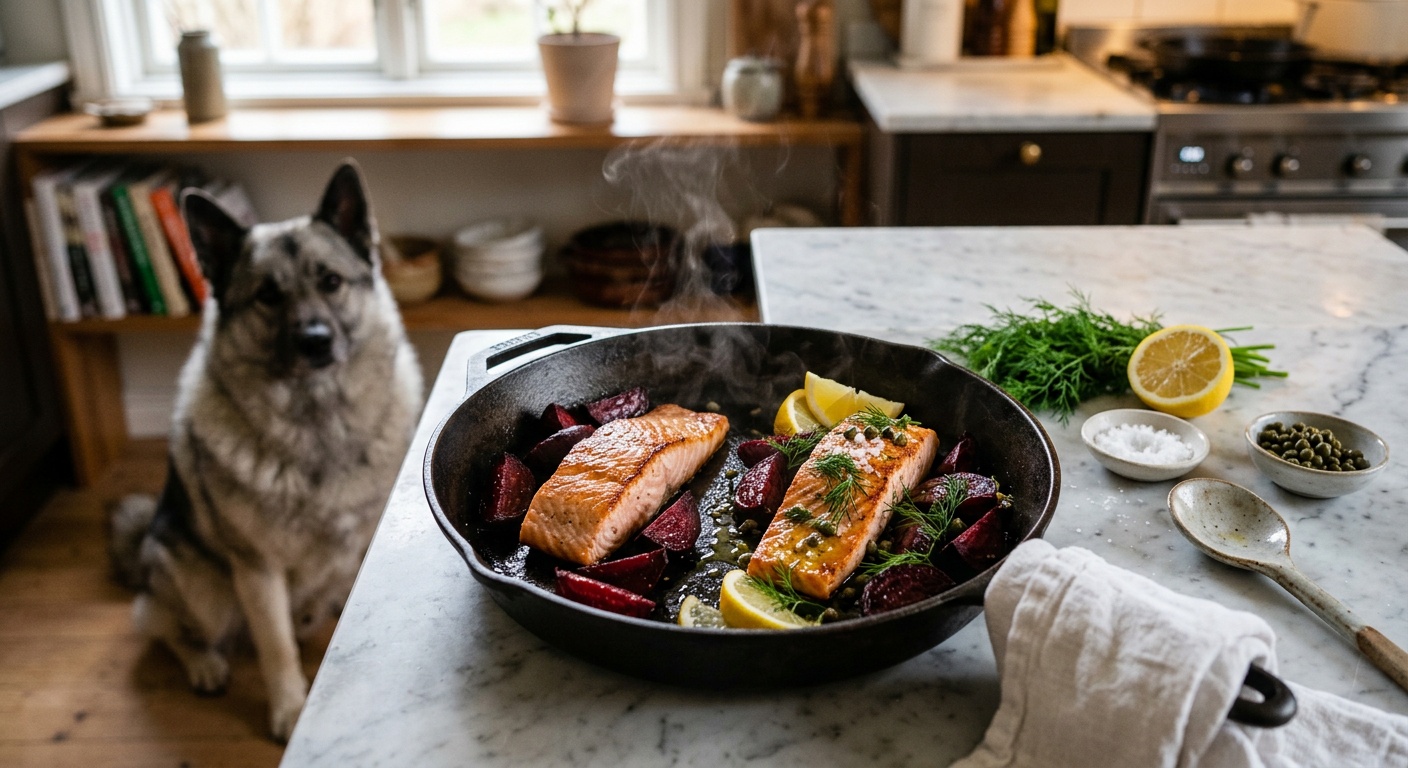
Pan-sear salmon with roasted beets and dill for yourself. Pull your dog's bowl before the lemon, capers and salt go in. Same kitchen, same fish, same table — two minutes apart.
Highest natural source of DHA and EPA omega-3. Also rich in niacin — a key NAD+ precursor for cellular energy and DNA repair.
Anthocyanins and polyphenols for cognitive support and antioxidant protection. One of the most studied longevity foods for dogs.
Natural nitrates support healthy blood flow and oxygen delivery. Folate, potassium and betalain pigments with anti-inflammatory action.
Low glycemic index, high in beta-glucan soluble fibre for gut health. Slower digestion means more stable energy throughout the day.
High water content for hydration. Silica supports coat and skin health. Potassium and vitamin K. Gentle and refreshing raw.
Anti-inflammatory compounds, calcium and flavonoids. A tiny pinch adds aroma without any risk — dogs tolerate dill well in small amounts.
Wild salmon is one of the richest natural sources of DHA and EPA omega-3 available. When salmon is the main protein in a meal, the fish oil supplement is not needed — the omega-3 is already covered by the protein itself. The only cold addition for this recipe is eggshell calcium to balance the calcium-phosphorus ratio.
Feed once or twice daily. If feeding twice, split these amounts in half per meal.
| Ingredient | Amount | Notes |
|---|---|---|
| 🐟 PROTEIN | ||
| Wild salmon (skinless, poached) | 110 g | Flake and check for bones before serving |
| Egg (scrambled, no butter/salt) | 1 whole (~50 g) | Adds niacin, riboflavin and complete amino acids |
| 🌾 GRAIN | ||
| Pearl barley (cooked, unsalted) | 45 g | Rinse well; cook in plain water |
| 🥦 VEGETABLES & FRUIT | ||
| Beets (steamed or roasted, plain) | 35 g | No salt, vinegar or oil — plain only |
| Cucumber (diced, raw) | 30 g | Skin on for silica content |
| Blueberries (fresh or frozen) | 15 g (~8 berries) | Thaw fully if frozen; no syrup |
| Fresh dill (chopped) | tiny pinch | Safe in small amounts; adds aroma |
| ❄️ COLD ADDITIONS (add after cooling) | ||
| Eggshell calcium powder | ¼ tsp | COLD |
| Ingredient | Amount | Notes |
|---|---|---|
| 🐟 PROTEIN | ||
| Wild salmon (skinless, poached) | 175 g | Flake and check for bones before serving |
| Egg (scrambled, no butter/salt) | 1 whole (~50 g) | Adds niacin, riboflavin and complete amino acids |
| 🌾 GRAIN | ||
| Pearl barley (cooked, unsalted) | 65 g | Rinse well; cook in plain water |
| 🥦 VEGETABLES & FRUIT | ||
| Beets (steamed or roasted, plain) | 50 g | No salt, vinegar or oil — plain only |
| Cucumber (diced, raw) | 45 g | Skin on for silica content |
| Blueberries (fresh or frozen) | 20 g (~10 berries) | Thaw fully if frozen; no syrup |
| Fresh dill (chopped) | ¼ tsp | Safe in small amounts; adds aroma |
| ❄️ COLD ADDITIONS (add after cooling) | ||
| Eggshell calcium powder | ¼ tsp | COLD |
| Ingredient | Amount | Notes |
|---|---|---|
| 🐟 PROTEIN | ||
| Wild salmon (skinless, poached) | 250 g | Flake and check for bones before serving |
| Egg (scrambled, no butter/salt) | 2 whole (~100 g) | Adds niacin, riboflavin and complete amino acids |
| 🌾 GRAIN | ||
| Pearl barley (cooked, unsalted) | 90 g | Rinse well; cook in plain water |
| 🥦 VEGETABLES & FRUIT | ||
| Beets (steamed or roasted, plain) | 70 g | No salt, vinegar or oil — plain only |
| Cucumber (diced, raw) | 55 g | Skin on for silica content |
| Blueberries (fresh or frozen) | 30 g (~15 berries) | Thaw fully if frozen; no syrup |
| Fresh dill (chopped) | ½ tsp | Safe in small amounts; adds aroma |
| ❄️ COLD ADDITIONS (add after cooling) | ||
| Eggshell calcium powder | ½ tsp | COLD |
| Ingredient | Amount | Notes |
|---|---|---|
| 🐟 PROTEIN | ||
| Wild salmon (skinless, poached) | 340 g | Flake and check for bones before serving |
| Egg (scrambled, no butter/salt) | 2 whole (~100 g) | Adds niacin, riboflavin and complete amino acids |
| 🌾 GRAIN | ||
| Pearl barley (cooked, unsalted) | 120 g | Rinse well; cook in plain water |
| 🥦 VEGETABLES & FRUIT | ||
| Beets (steamed or roasted, plain) | 90 g | No salt, vinegar or oil — plain only |
| Cucumber (diced, raw) | 70 g | Skin on for silica content |
| Blueberries (fresh or frozen) | 40 g (~20 berries) | Thaw fully if frozen; no syrup |
| Fresh dill (chopped) | ½ tsp | Safe in small amounts; adds aroma |
| ❄️ COLD ADDITIONS (add after cooling) | ||
| Eggshell calcium powder | ½ tsp | COLD |
Wild salmon is arguably the most complete single protein you can give a dog. It provides DHA and EPA omega-3 at therapeutic levels, niacin (B3) as a NAD+ precursor for cellular energy, and high-quality complete protein. Wild-caught is significantly higher in omega-3 than farmed. Poach gently — never season with salt, garlic or lemon before serving to your dog. Always check for pin bones before serving.
Beets are safe for dogs and genuinely underused in homemade food. The natural nitrates support healthy circulation — the body converts them to nitric oxide, which relaxes blood vessels. Betalain pigments (what gives beets their deep purple-red colour) have anti-inflammatory and antioxidant properties. Folate supports cell division and DNA synthesis. Steam or roast plain — no vinegar, salt or oil.
⚠️ Beets will turn your dog's urine and stool temporarily pink or red. This is harmless — it's the betalain pigment. Don't be alarmed.
Barley is one of the oldest cultivated grains and one of the most nutritionally interesting for dogs. Its beta-glucan content is among the highest of any grain — this soluble fibre acts as a prebiotic, feeding beneficial gut bacteria. It also has a lower glycemic index than white rice, producing a slower, more stable rise in blood glucose. Good for dogs that benefit from weight management.
Blueberries appear in multiple Breed-to-Bowl recipes for good reason. They are among the most antioxidant-dense fruits safe for dogs — providing anthocyanins, quercetin and pterostilbene. Research in dogs has found improved cognitive function in older dogs given blueberry supplementation. Frozen and fresh are equally good nutritionally. Serve as part of the bowl rather than as a separate treat.
Dill is safe for dogs in small quantities and has been used as a digestive herb for centuries in Nordic and Eastern European cooking. It contains flavonoids and monoterpenes with mild anti-inflammatory activity. A tiny pinch adds genuine aroma to your dog's bowl without any of the risks associated with stronger herbs like garlic or onion. Never feed the dried concentrated form in large quantities.
Egg is one of the most bioavailable complete proteins in existence. For NAD+ support specifically, eggs provide both niacin (B3) and riboflavin (B2) — riboflavin is a cofactor in the NADH-to-NAD+ recycling pathway. Scramble without butter, milk or salt. The yolk provides fat-soluble vitamins A, D and E. Scrambled is easier to digest than raw for most dogs.
Rinse pearl barley thoroughly under cold water. Add to a pot of unsalted cold water (roughly 3 parts water to 1 part barley) and bring to a boil. Reduce to a simmer and cook for 25–30 minutes until tender but not mushy. Drain and set aside. Barley takes longer than everything else — start this first.
If steaming: dice into small cubes (1–1.5 cm), place in a steamer basket and steam for 15–18 minutes until fork-tender. If roasting: spread on a baking tray with a splash of water, cover with foil, and roast at 200°C for 25–30 minutes. No oil, no salt, no vinegar — plain. Set aside to cool.
💡 Wear gloves when handling raw beets — the pigment stains everything.Place your dog's salmon portion in a shallow pan. Cover with cold water — the water should just cover the fish. Bring slowly to a gentle simmer over medium heat. Poach for 8–10 minutes until the salmon is opaque throughout and flakes easily. No salt, no lemon, no seasoning at all. Remove from the water and let it cool completely on a plate.
Pat your fillet dry. Season generously with flaked sea salt, black pepper and fresh dill. Heat a little olive oil in a pan over medium-high heat until shimmering. Place the salmon skin-side up and sear for 3–4 minutes. Flip and cook 2–3 minutes more. Finish with a squeeze of lemon and scatter capers if you like. Serve alongside roasted beets and a simple cucumber, dill and yoghurt salad.
In a small non-stick pan with no butter or oil, scramble one or two eggs over low heat until just set. No salt, no milk. Allow to cool before adding to the bowl.
Check your dog's salmon is fully cool. Flake it into the bowl and check carefully for any pin bones — run your fingers along the flesh. Add the cooked barley, steamed beets, diced raw cucumber, blueberries and scrambled egg. Add the tiniest pinch of fresh dill. Mix gently.
🌡️ The bowl must be cool to room temperature before adding the eggshell calcium.Once completely cool: stir in eggshell calcium powder. That's it — omega-3 is fully covered by the salmon itself, so no fish oil is needed for this recipe. Serve immediately or refrigerate for up to 2 days.
❄️ Never add eggshell calcium to a warm bowl — heat isn't an issue for calcium, but always cool the bowl first so you don't forget the cold rule on other recipes.The Norwegian Elkhound is one of the oldest dog breeds in the world. Archaeological evidence places them in Scandinavia more than 6,000 years ago — used to hunt elk, bear and wolf in environments where the diet was almost entirely fish, game and foraged food. They are, in the most literal sense, a dog that evolved to eat exactly what this recipe contains.
Norwegian Elkhounds are a generally robust breed, but they do have specific health tendencies that make this recipe particularly well-suited:
This recipe wasn't designed with the longevity series in mind — but it happens to tick several of the boxes we've been building toward. Salmon provides niacin, the primary dietary NAD+ precursor we covered in Part 5. Blueberries provide quercetin, the most studied natural senolytic compound from Part 4. Beets provide nitrates that support blood vessel health and circulation. Barley provides prebiotic fibre that feeds the diverse gut microbiome we covered in the gut health post. It's not a magic recipe — but it is a very well-stacked one.
One cook, two dinners — the best way to feed your dog well without cooking twice.
See All Recipes →